

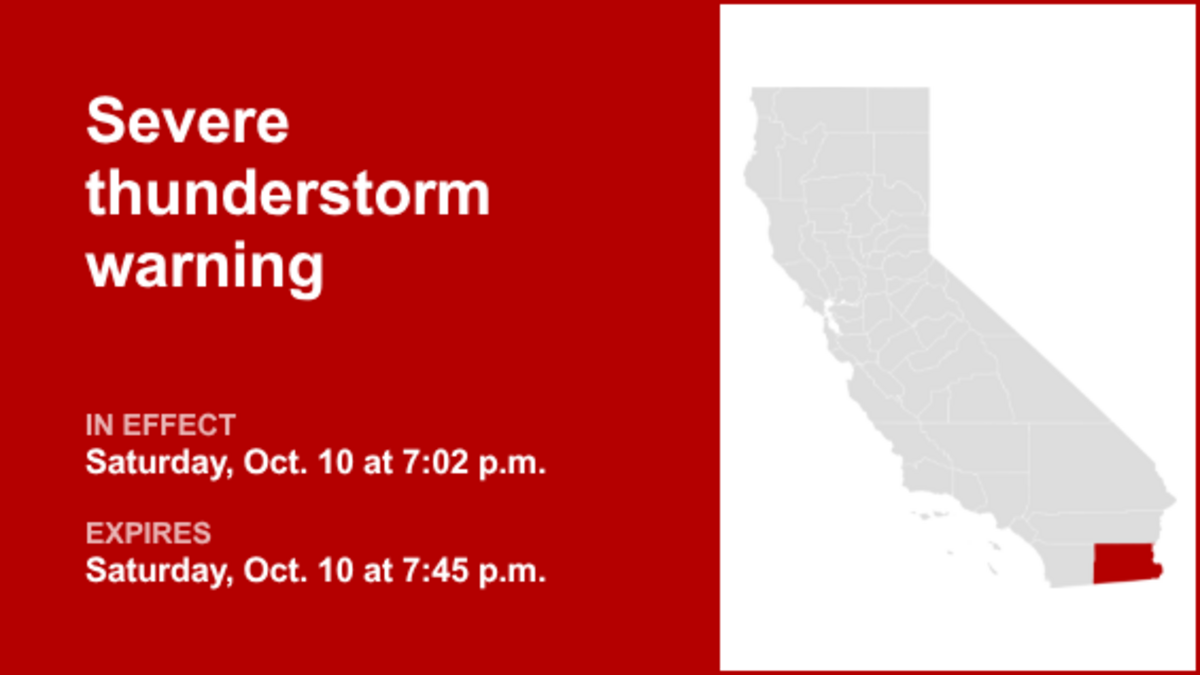

Severe Thunderstorm Warning Issued for Imperial County

At 7:02 p.m. on Saturday, the National Weather Service (NWS) Phoenix AZ released a severe thunderstorm warning in effect until 7:45 p.m. for Imperial County. Residents in the affected areas should prepare for wind gusts of up to 60 mph, which can cause significant damage to properties and pose serious risks to personal safety.
Storm Details and Affected Areas
According to the NWS, at 7:02 p.m., a severe thunderstorm was located near Somerton, moving north at 35 mph. The storm is expected to impact a wide range of communities, including Yuma, Somerton, Gadsden, Fortuna Foothills, San Luis, Araby, Winterhaven, Andrade, and Blaisdell. Officials warn that damage to roofs, siding, and trees is likely as the storm progresses.
Safety Precautions During Severe Thunderstorms
The NWS advises residents to seek shelter inside a well-built structure and stay away from windows. This storm is capable of producing damaging winds, making outdoor exposure extremely hazardous. It is crucial to have a plan in place to reach a safe area if you are caught outside when severe weather strikes.
Lightning Safety: What to Know
Lightning strikes the United States about 25 million times a year, most commonly during the summer months, resulting in approximately 20 fatalities annually. The risk of lightning increases as a thunderstorm approaches, peaks when the storm is overhead, and diminishes as the storm moves away. Understanding these patterns can help individuals take timely precautions.
Key lightning safety recommendations include:
- Reduce the chance of being struck by lightning by having a plan to get to a safer area when venturing outside.
- If the sky grows ominous and thunder is heard, seek out a safe place to take shelter immediately.
- Once indoors, avoid touching corded phones, electrical equipment, plumbing, and windows and doors.
- Wait for 30 minutes after the final lightning or thunder before heading outside again.
If finding indoor shelter is not an option:
- Avoid open fields, hill peaks, or ridge tops.
- Avoid tall, isolated trees or other elevated objects. If in a forest, stick to areas with shorter tree cover.
- If in a group, spread out to avoid the current traveling between group members.
- If camping in an open area, set up camp in a valley, ravine, or other low area. Remember, a tent offers no protection from lightning.
- Do not approach water, wet objects, or metal items. Although water and metal do not attract lightning, they conduct electricity effectively.

Driving in Rain: Essential Safety Tips
When driving during heavy rain, certain practices can significantly reduce the risk of accidents and improve overall safety:
- Turn on your headlights – Even when it’s light outside, using headlights can improve visibility and alert other drivers to your presence.
- Stick to the middle lanes and stay on elevated ground – Rainwater tends to accumulate at the road edges.
- Keep clear of puddles – Driving through puddles or low rainwater areas can cause vehicles to hydroplane or skid out of control.
- Do not follow large vehicles closely – Large vehicles like trucks or buses can create a spray of water that can reduce your visibility.
- Avoid flooded areas – When encountering a flooded road, do a U-turn and head back. The strong currents from flash floods can pull drivers off roadways. Driving through deep water can also negatively affect a vehicle’s mechanical and electrical systems.
Understanding Hydroplaning and How to Respond
Hydroplaning occurs when a vehicle begins sliding uncontrollably on wet roads. This happens when water in front of the tire builds up faster than the vehicle’s weight can push water out of the way. The water pressure then causes the vehicle to rise and slide on a thin layer of water between the tires and the road, making the driver lose control. The top three contributors to hydroplaning are vehicle speed, water depth, and tire tread depth.
In the event of your vehicle hydroplaning, follow these steps:
- Ease off the accelerator – Step off the gas to slow down the vehicle until the tires find traction.
- Turn into the skid – Turning into the skid can help the vehicle’s tires realign to regain control.
- Make sure the tires reconnect with the road – During the skid, wait until the tires reconnect with the road and then gently straighten the wheels to regain control.
- Brake gently as needed – Brake normally if the vehicle has anti-lock brakes and pump brakes gently if in an older vehicle.
Additional Resources and Information
For the most up-to-date information on severe weather warnings and safety guidelines, residents are encouraged to monitor official sources such as the National Weather Service. Staying informed and prepared can make a significant difference during extreme weather events.
Source: The National Weather Service
United Robots California
This story was originally published October 10, 2026 at 7:06 PM.
News, Government, Health, Transportation, Vehicles, Science, Society, Weather, Safety, Driving, Hydroplaning


