

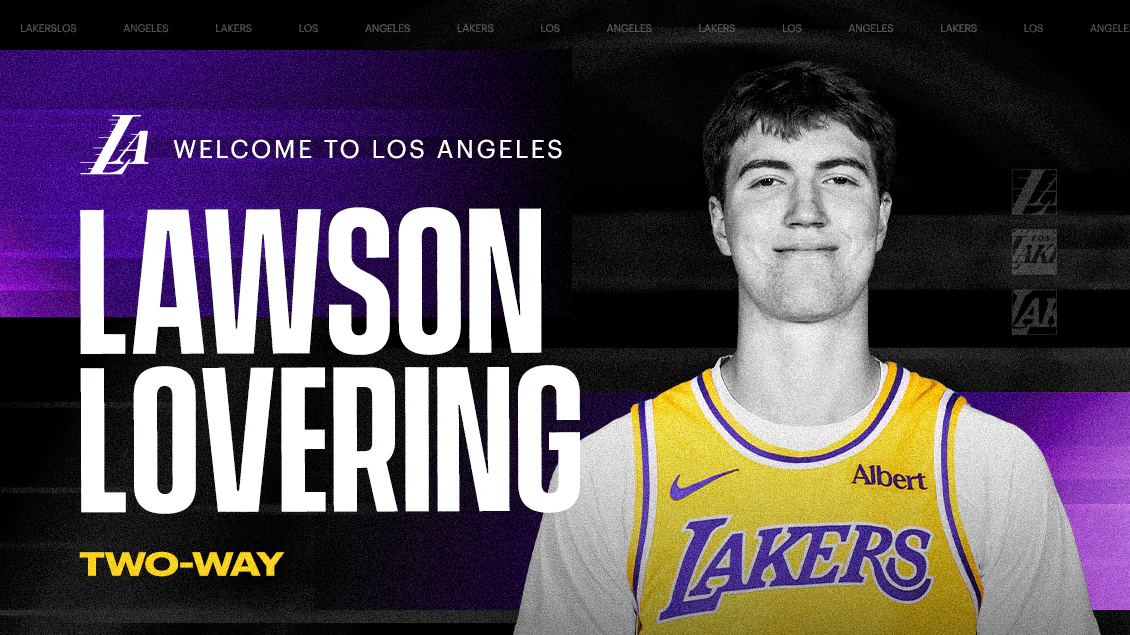

Los Angeles Lakers Sign Center Lawson Lovering to Two-Way Contract
The Los Angeles Lakers have signed center Lawson Lovering to a two-way contract, adding a young, 7-foot interior presence to the organization’s depth chart. Lovering, who played college basketball for the Colorado Buffaloes, joins a Lakers frontcourt looking for additional size, rebounding, and rim protection. Under the terms of a two-way deal, he will divide his time between the NBA club and the South Bay Lakers, the team’s G League affiliate, giving the franchise roster flexibility while giving Lovering a pathway to prove himself at the professional level.
For Los Angeles, the signing is a relatively low-risk move with potential upside. For Lovering, it is an opportunity to transition from college basketball to the NBA system and compete for a more permanent role.
Who Is Lawson Lovering?
Lawson Lovering spent his collegiate career at the University of Colorado, where he developed a reputation as a mobile, defensive-minded big man. Listed at roughly 7 feet tall, Lovering offers the kind of horizontal size that NBA teams value in backup centers, particularly players who can switch defensively, protect the rim, and finish around the basket in transition. While he may not yet be a finished offensive product, his combination of height, length, and motor made him an interesting prospect for teams seeking affordable frontcourt depth.
The Lakers have emphasized adding versatile big men who can defend multiple positions and contribute without dominating the ball. Lovering fits that profile as a developmental piece rather than an immediate rotation player.
What a Two-Way Contract Means for Lovering
A two-way contract allows a player to split time between an NBA team and its G League affiliate. Two-way players can appear in up to 50 NBA games during a season while spending the rest of their time with the affiliate—in this case, the South Bay Lakers. The arrangement combines NBA and G League compensation under league guidelines.
For Lovering, the deal means he will not automatically be confined to one level. He could participate in Lakers practices and shootarounds, travel with the team on occasion, and receive NBA game action if injuries or matchups create opportunities. The rest of his development will likely happen with South Bay, where he can gain consistent minutes against professional competition.
NBA Two-Way Deal Basics
Under NBA rules, two-way contracts are generally available to players with three or fewer years of NBA service. Teams can convert them into standard contracts if roster space becomes available. The salary-cap implications are more favorable than a full minimum contract, which makes such deals useful for teams managing payroll while trying to fill out their roster.
Lakers Frontcourt Depth and Roster Strategy
Anthony Davis remains the undisputed anchor of the Lakers’ frontcourt, but the team has long sought dependable depth behind him at center and power forward. Injuries and load management have made backup big men crucial in recent seasons, and the Lakers have routinely used two-way and minimum contracts to find affordable interior help.
Lovering enters a center group that includes other young and veteran options, though his two-way status means he will not guarantee regular NBA minutes. Instead, he provides the Lakers with an extra body in camp and a player they can develop in the G League without committing a full roster spot or significant salary. If he impresses during summer league or training camp, he could earn more looks; if not, the Lakers retain his rights in the G League system without a long-term obligation.
Summer League, Training Camp, and the Road Ahead
Lovering’s immediate future will likely involve the NBA Summer League and Lakers training camp, where coaching staff will evaluate his conditioning, defensive rotations, and offensive decision-making against other prospects and young professionals. Strong performances could lead to NBA appearances during the regular season, while quieter showings would send him to South Bay for extended G League minutes.
The signing does not transform the Lakers’ championship outlook overnight, but it does address a recurring need for frontcourt insurance. For a player like Lovering, simply earning a two-way contract with a marquee franchise is a significant step. Whether he eventually earns a standard NBA deal—or becomes a reliable G League call-up—will depend on how quickly he adapts to the speed and physicality of professional basketball.
The Lakers’ decision to sign Lawson Lovering to a two-way contract reflects a pragmatic approach to roster building: add size and potential without jeopardizing financial flexibility. Lovering brings raw tools and college experience to an organization that has historically developed young big men through its G League pipeline. While he is unlikely to play a major role immediately, the move gives both player and team a low-stakes opportunity to see if the fit works. For Lakers fans, it is worth watching how Lovering performs in South Bay and whether he can translate his collegiate shot-blocking and rebounding into NBA minutes down the road.
Sports, News, Los Angeles Lakers, Lawson Lovering, NBA, Colorado Buffaloes, South Bay Lakers, Two-Way Contract, G League, Basketball, Center, NBA Summer League


