

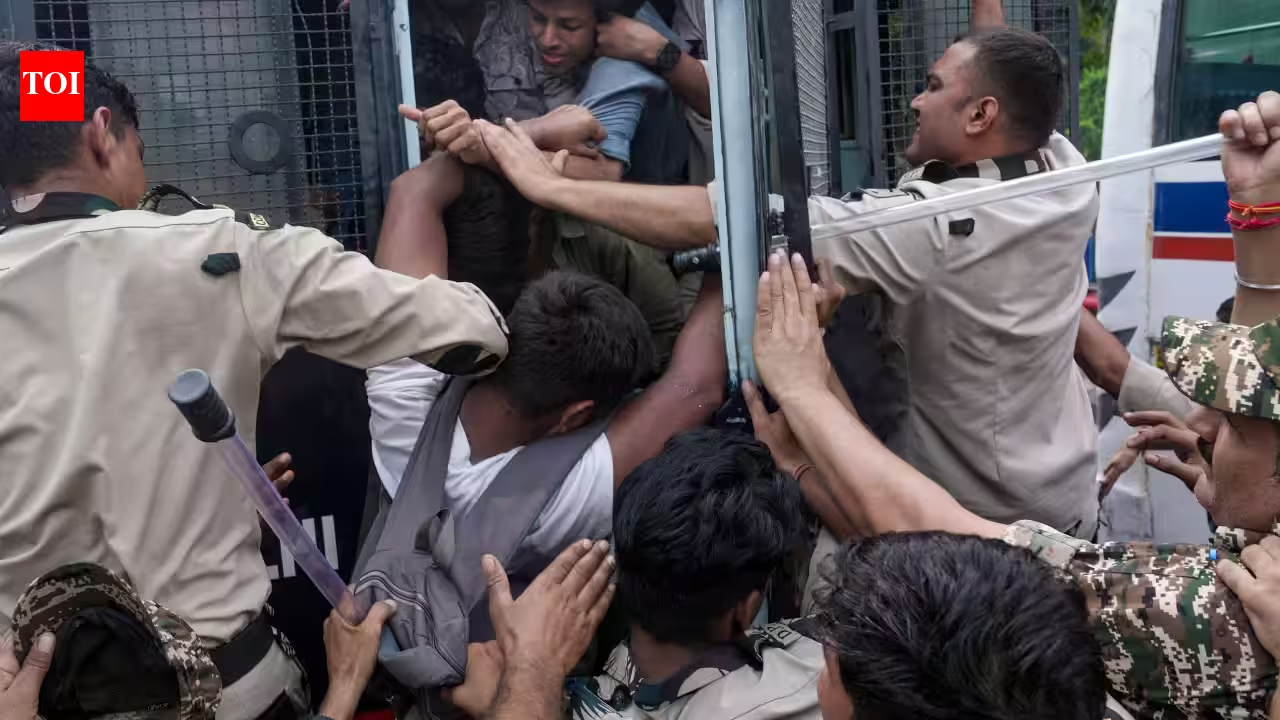

Delhi Security Clampdown: Thousands Detained as CJP Protests Election Roll Irregularities
The national capital witnessed a massive security operation this weekend as the Delhi Police moved to thwart a planned demonstration by the Cockroach Janta Party (CJP). The protest, aimed at the Chief Election Commissioner Gyanesh Kumar, was organized to voice grievances over alleged discrepancies in the Special Intensive Revision (SIR) of electoral rolls and contentious changes to Form 6, the primary document used for voter registration.
Citing urgent law-and-order concerns and a lack of procedural permissions, authorities implemented a sweeping security blanket across central Delhi. The resulting crackdown led to the detention of over 7,000 individuals, including high-profile political leaders, activists, and digital influencers, sparking a heated debate over the right to dissent in the “Mother of Democracy.”
Heavy Security Measures and Urban Paralysis
To prevent protesters from reaching Jantar Mantar, the Delhi Police deployed an extensive array of surveillance and containment tools. The security apparatus included the use of drones and body-worn cameras to monitor movements in real-time, alongside the deployment of heavy barricading at key entry points to the city center.
- Traffic Diversions: Major arterial roads in central Delhi were blocked or diverted.
- Transport Restrictions: Public transport access to sensitive zones was severely limited.
- Digital Blackout: Intermittent restrictions on mobile internet services were reported to prevent the coordination of flash mobs.
High-Profile Detentions: From Political Giants to Influencers
The police operation was characterized by preemptive detentions targeting the leadership of the CJP and various opposition allies. In a striking move, CJP leaders Abhijeet Dipke, Saurav Das, and Ashutosh Ranka were taken into custody while still on an aircraft upon their arrival at the Delhi airport from Mumbai.
The crackdown extended beyond political party members to include influential voices and veteran statesmen. Notable detentions included:
| Person/Group | Context of Detention |
|---|---|
| Dhruv Rathee | Detained from his residence in Gurugram. |
| Arvind Kejriwal | Former Delhi CM detained during police sweeps. |
| Mamata Banerjee | Former WB CM; reported a sit-in at Dwarka North police station. |
| Pinarayi Vijayan | Kerala CM detained alongside other opposition figures. |
CJP’s Defiant Response
Following the arrest of its core leadership, the Cockroach Janta Party shifted its mobilization strategy. National organization in-charge Ajinkya Shinde urged supporters to continue their march regardless of the obstacles. In a statement that echoed a spirit of resilience, Shinde declared: “If Delhi Police tries to stop you, wherever they stop you will become your Jantar Mantar.”
Clashes and Allegations of State Suppression
The tension culminated in sporadic violence. Reports indicate that six Delhi Police personnel, including an officer from the Pink Force, sustained injuries during the detentions. Police officials cited instances of stone-pelting near Akashwani Bhawan and the Hanuman temple in Connaught Place as justification for the stringent measures.
“The government has turned the ‘Mother of Democracy’ into a ‘Muzzled Democracy’.”
— Mallikarjun Kharge, Congress Leader
The Congress party, through leaders like Rahul Gandhi and Priyanka Gandhi, condemned the restrictions as an attempt to stifle democratic dissent. Conversely, the BJP stood by the law enforcement agencies. Ravi Shankar Prasad emphasized that the stability of the nation relies on institutional processes, stating that the country should be “governed by Parliament and not the streets.”
Analysis: The Core of the Dispute
At the heart of this unrest is a technical but critical dispute over voter registration. The CJP’s focus on Form 6 and the Special Intensive Revision (SIR) suggests a deep-seated concern over electoral integrity. When citizens believe the process of adding or verifying names on the electoral rolls is being manipulated, it often leads to systemic distrust in the election machinery.
The scale of the detentions—exceeding 7,000 people—highlights the high stakes of the current political climate in India. The clash between the government’s mandate to maintain public order and the citizens’ right to peaceful assembly remains a central point of contention in the capital’s administrative approach to political protests.
News, Government, Law, Society, India, Delhi, Politics, Election Commission of India, Cockroach Janta Party, CJP, Voter Registration, Civil Liberties, Human Rights, Controversial, Critical, Democratic Protest, Law Enforcement, Delhi Police


