

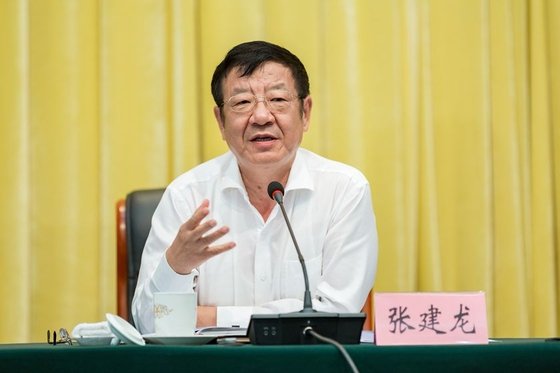

Zhang Jianlong Case: Former Forestry Bureau Chief Censured for ‘Lip Service’ to Central Directives
The case of Zhang Jianlong, former director of China’s National Forestry and Grassland Administration, has been communicated through official disciplinary channels over allegations that he offered verbal support to central directives while failing to carry them out in practice. The phrase attached to the case—“只表态不落实,” commonly rendered in English as “only making statements without implementation”—points to a specific and politically sensitive failure: the gap between policy endorsement and actual execution.
For readers following Chinese governance, environmental administration, or public accountability, the case matters because it illustrates how Beijing frames implementation failures not merely as administrative oversights, but as violations of political discipline. When a senior official overseeing forestry and grassland policy is singled out for “lip service,” the signal extends beyond one individual to the entire bureaucracy responsible for delivering China’s ecological and environmental targets.
The Core Allegation: ‘Only Making Statements Without Implementation’
In the context of Chinese official communications, “只表态不落实” is more than a critique of poor management. It describes a pattern in which a leader publicly aligns with central leadership—issuing statements, attending meetings, and expressing loyalty—while directing subordinates or departments to delay, dilute, or ignore concrete action on the ground. The phrase carries particular weight when applied to forestry and grassland administration, an arena where central directives on afforestation, land degradation, and ecological protection require sustained, long-term execution across vast and varied terrain.
Available reporting on the Zhang Jianlong case indicates that the communicated criticism centered on this disconnect between rhetorical support for central policy and measurable implementation. Whether the allegations involve specific forestry projects, ecological initiatives, or broader administrative directives, the framing suggests that verbal agreement with Beijing’s priorities was treated as insufficient without corresponding administrative action.
Zhang Jianlong’s Role at the Forestry and Grassland Administration
Zhang Jianlong served as a senior leader within China’s forestry bureaucracy, most recently as director of the National Forestry and Grassland Administration, the agency responsible for managing the country’s forest resources, grasslands, wetlands, desertification control, and related ecological programs. The position placed him at the intersection of environmental policy, rural land management, and national campaigns such as large-scale tree planting and biodiversity protection.
Because the agency operates under multiple layers of central planning—including ecological civilization targets and climate-related commitments—its leaders are expected to translate national strategy into regional action. A case involving its former chief, communicated under the language of “lip service without implementation,” therefore touches on one of the government’s persistent challenges: ensuring that top-down environmental and land-use policies produce results at the provincial, county, and township levels.
What ‘只表态不落实’ Signals About Chinese Governance
The phrase has become a recurring theme in Chinese political discourse, particularly during anti-corruption and discipline inspections. It reflects a leadership concern that officials may prioritize political signaling—public demonstrations of alignment with central priorities—over the routine, often unglamorous work of policy delivery. In the forestry sector, that gap can manifest as planting targets met on paper but not in surviving forests, or ecological protection directives issued without local enforcement.
By publicly identifying this behavior in a senior forestry official, disciplinary authorities appear to be reinforcing the expectation that loyalty to central policy must be accompanied by administrative accountability. The communicated case functions both as a corrective measure for the individual involved and as a warning to other officials in natural-resource management that rhetorical compliance is not a substitute for execution.
Accountability, Consequences, and Administrative Signaling
Official communications of this nature typically precede or accompany formal disciplinary procedures, though the specific measures taken against Zhang Jianlong have not been detailed in the available source material. Cases framed around “only表态不落实” often result in party disciplinary actions, administrative sanctions, or removal from leadership positions, depending on the severity of the findings and the outcomes of inspection processes.
The broader consequence is organizational. When a bureau chief is publicly censured for implementation failures, it tends to trigger internal reviews within the agency, heightened scrutiny of ongoing projects, and a ripple effect across subordinate forestry and grassland offices. For an administration tasked with ecological programs that span decades and millions of hectares, such signaling can shift internal incentives from visible political gestures to verifiable field outcomes.
Reported Disciplinary Context and Public Messaging
Public notices involving senior officials in China generally follow a pattern: the case is “communicated” (通报) to party members and government staff, the nature of the violation is summarized, and disciplinary steps are announced or implied. In this instance, the public emphasis on “lip service without implementation” suggests the messaging is intended to be instructive rather than merely punitive. It frames the alleged misconduct as a governance failure that other officials are expected to recognize and avoid.
Outlook: Implementation Over Rhetoric in Environmental Governance
The Zhang Jianlong case should be understood as part of a broader tightening of accountability within China’s environmental and natural-resource bureaucracy. As the country advances ambitious targets related to carbon peaking, carbon neutrality, and ecological restoration, the pressure on forestry and grassland officials to deliver concrete results is likely to increase. Cases communicated under language like “只表态不落实” indicate that Beijing is prepared to treat symbolic compliance as a disciplinary matter when it obstructs policy delivery.
For observers of Chinese public administration, the episode highlights a recurring tension in centralized systems: the difficulty of ensuring that directives issued in Beijing are fully carried out in distant provinces and counties. Whether this particular case leads to broader reforms in how forestry performance is monitored remains to be seen, but its public communication makes clear that the standard for senior officials now includes not only stating support for central requirements, but demonstrating that those requirements have been implemented.
“只表态不落实” — “Only making statements without implementation”
Government, News, People, Society, China, Chinese Government, National Forestry and Grassland Administration, Public Officials, Political Discipline, Policy Implementation, Forestry Management, Ecological Civilization, Accountability


