

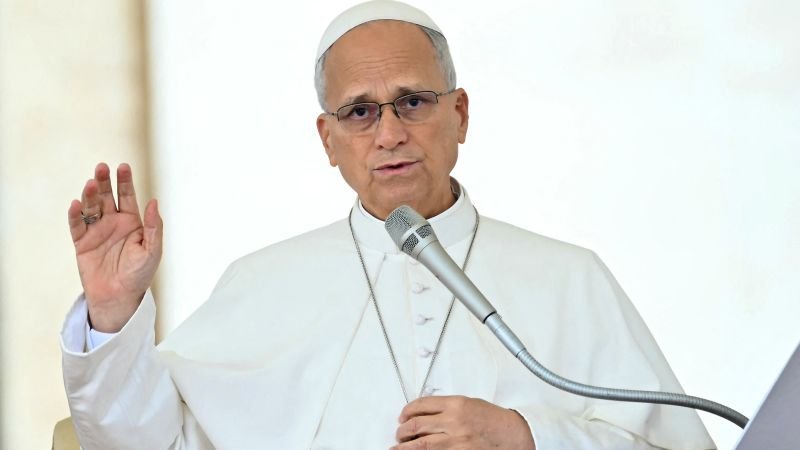

Pope Leo XIV Casts Mail-In Ballot in U.S. Midterm Elections, Making History
Rome — Pope Leo XIV has made history as the first pontiff to participate in a U.S. secular democratic election, casting a mail-in ballot for the upcoming American midterm elections. Announced by the Vatican on Friday, this unprecedented act underscores the intersection of faith, citizenship, and democracy within the Catholic Church’s highest office.
Pope Leo XIV has submitted a mail-in ballot for the US midterms, becoming the first pope to vote in a US election and likely the first to vote in a secular democratic election.
The first American pope “has submitted his mail-in ballot in Chicago,” the Vatican said in a statement Friday. “The Holy Father expresses his belief in the right and the duty of citizens to participate in democratic processes,” the statement said.
Michael Walsh, a British historian and author who has written several books on the papacy, said Leo XIV would be the first pope to vote in a democratic, secular election.
“I don’t think popes have ever voted in a democratic election before,” he told CNN.
Records show that the pope is registered under his baptismal name, Robert Francis Prevost, to vote in the Chicago suburb of New Lenox, where his brother John lives. The Chicago-born pontiff has cast ballots in both Republican and Democratic primaries in recent years and cast a vote in the 2024 presidential election.
Vatican Statement Highlights Democratic Participation
Since his election to the papacy in May 2025, the pope has encouraged civic involvement, urging people to make their voices heard about the US-Israel war against Iran.
The pope has clashed with President Donald Trump’s administration over the war in Iran and its immigration crackdown and earlier this year, the president launched an unprecedented set of broadsides against Leo XIV. Trump has been less critical of him lately — frequently talking about how the pope’s eldest brother, Louis, is a supporter of his.
The pope’s ballot is expected to include votes for the senate and governor race in Illinois, along with house of representative, state and county elections.
Illinois Political Connections and Historical Engagements
He met JB Pritzker, a candidate for Illinois governor, in the Vatican in November 2025. The pair discussed immigration enforcement, although the pope later expressed his disapproval of Illinois’ legislation for medically assisted death, signed by Pritzker.
Leo XIV has shown his interest in Illinois politics over the years. In 2011, when he was Rev. Robert Prevost, he personally messaged the then Governor of Illinois Pat Quinn to thank him for abolishing capital punishment in Illinois, Prevost’s home state.
It’s not clear if the pope sent his ballot by mail from the Vatican, although his brother, John, was in the Vatican on Wednesday with a group of pilgrims from St Jude’s Parish, New Lenox, for a meeting with the pope. Before the Vatican statement on Wednesday, an official from Will County clerk’s office had told the Chicago Sun-Times that Robert Francis Prevost was among a “list of individuals who requested a vote by mail ballot for the upcoming election.”
Even though he is a head of state, the pope remains a US citizen and is permitted to vote in the US elections.
CNN has asked the Will County Clerk’s office for comment.
Laura Sharman contributed to this report.
Legal and Canonical Implications of Papal Voting
The act of voting raises canonical questions regarding the role of the papacy and its engagement with temporal affairs. While traditionally maintaining a stance of neutrality in political matters, Pope Leo XIV’s decision reflects his commitment to active citizenship, aligning with modern interpretations of religious leadership that encourage social responsibility beyond spiritual guidance.
Historically, popes have refrained from participating in elections outside the Vatican City State, respecting the principle of separating church and state. However, as a naturalized Italian citizen and former bishop in Peru, Pope Francis (now Saint Francis) never held U.S. citizenship. In contrast, Pope Leo XIV’s dual identity as both a religious leader and American expatriate introduces a novel dimension to papal protocol.
“His participation signals a shift toward greater lay involvement in democratic processes, encouraging Christians worldwide to engage civically without compromising ecclesiastical independence.”
— Vatican spokesperson, via statement
Canon law does not explicitly prohibit popes from voting in foreign elections, particularly those involving their countries of origin. This ambiguity allows for flexible interpretation based on individual conscience and pastoral priorities. Pope Leo XIV’s actions may influence future discussions among canon lawyers and theologians about the boundaries of papal political engagement.
U.S. Citizenship and Voting Rights for the Pope
Despite holding the highest office in the Catholic Church, Pope Leo XIV retains his U.S. citizenship, granted at birth in Chicago. Federal election regulations permit overseas citizens to vote absentee, including clergy and religious leaders. As such, his ballot adheres to standard procedural norms, requiring notarization and submission through diplomatic channels if mailed internationally.
The Will County Clerk confirmed receipt of thousands of absentee ballots nationwide, with some submitted from diplomatic residences abroad. While no official source verified whether the pope personally signed his ballot or delegated the task to staff, experts suggest symbolic intent outweighs practical mechanics. The gesture itself serves as a powerful statement about global interconnectedness and moral stewardship.


