


Elephants and the Enigmatic Language of Grief: What Science Reveals About Animal Cognition
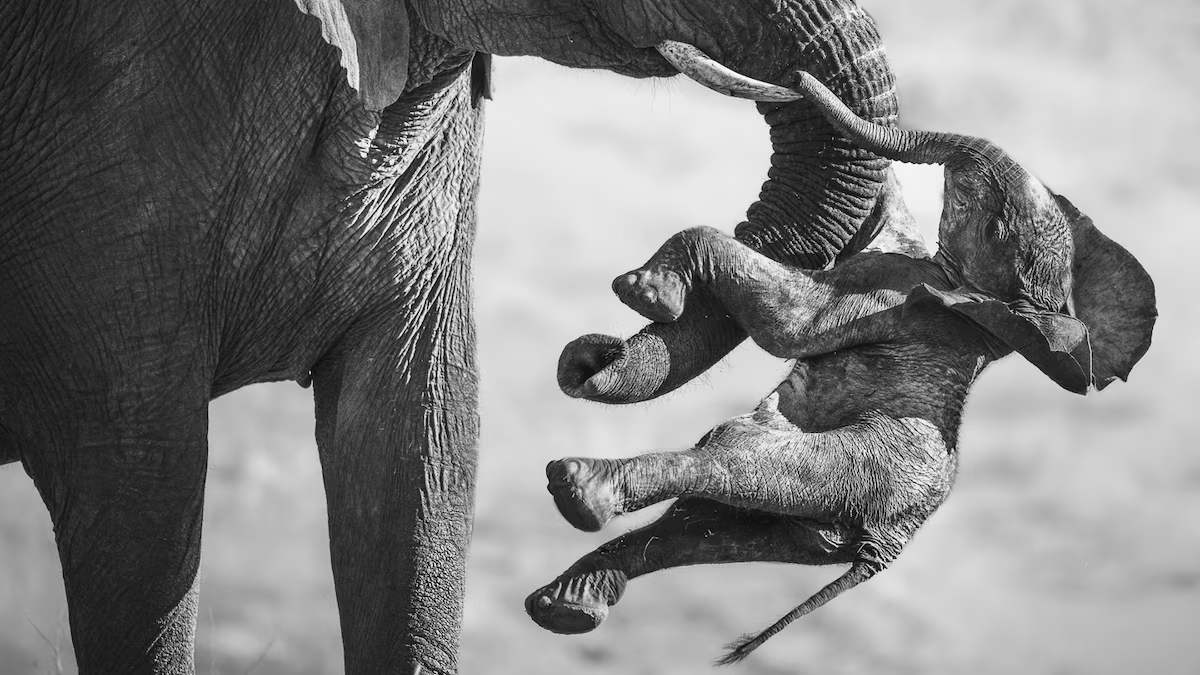
In a moment that stirred both awe and introspection, a photograph of an elephant draped in the unmistakable guise of mourning captured the world’s attention. The image, taken by wildlife photographer Paolo Veronesi, earned acclaim not just for its artistic merit but for what it reveals about the emotional depth of non-human species. “This photograph works on so many levels,” said competition chair Kathy Moran in a press release. “Emotionally it’s a gut punch, heartbreakingly poignant. Intellectually it’s proof that animals have cognition. This photograph says it all!” The scene—featuring an orphaned female elephant carrying a calf up a rocky terrain—has become a powerful testament to the complex lives of these majestic creatures.
The Enigmatic Behavior of Elephant Mourning
Both African and Asian elephants have long exhibited behaviors that suggest they experience a form of mourning. Researchers have documented cases where relatives and even non-related elephants gather around deceased herd members, gently touching the bodies with trunks, remaining silent, or arranging remains in distinctive ways. These actions have led scientists to ponder whether these rituals signify grief—a concept once thought to be uniquely human.
Veronesi’s subject was no different. His encounter with the elephant, who had previously lost a calf, revealed a behavior pattern that speaks to profound emotional complexity. “There is a lot going on in them trying to make sense of death, in a way, and this baby was certainly part of that relationship,” Veronesi explained. The female’s repeated acts of picking up dead calves, often at great physical effort, suggest a compulsive need to reconnect with lost loved ones. This behavior transcends simple instinct—it hints at a psychological need to process loss.
Scientific Debate and Broader Implications
Theories about animal cognition have evolved dramatically in recent decades. Once dismissed as anthropomorphic, the idea that animals experience emotions like grief or empathy now finds support in peer-reviewed studies and observational evidence. A 2023 study published in Animal Cognition highlighted elephants’ ability to recognize themselves in mirrors—a trait linked to self-awareness. Other research points to their capacity for long-term memory, cooperative problem-solving, and even cultural transmission of behaviors.
Yet debates persist. Critics argue that interpreting animal behavior through a human lens risks oversimplification. “We must avoid projecting our emotions onto animals,” cautioned Dr. Sarah Bell, a comparative psychologist at the University of Cambridge. “While elephants exhibit fascinating behaviors, we should base conclusions on rigorous, peer-reviewed evidence.” Still, the accumulation of data continues to challenge anthropocentric views of intelligence.
The Photographer’s Perspective
Veronesi, who spent years documenting wildlife across Africa and Asia, described the moment as “chillingly surreal.” He witnessed the elephant’s dedication firsthand—occasionally pausing to nuzzle the calf’s remains before resuming her labored journey. “She didn’t seem like one who’d recently given birth,” Veronesi noted, prompting him to consult local researchers. Their insights revealed a history of similar behaviors, suggesting a cycle of loss and remembrance.
“It’s probably a way for her to try to reconnect to that experience in a way,” Veronesi concluded. “It shows an even higher level of complexity of emotions and reactions.” Such observations underscore the urgency of understanding elephant psychology, especially in the face of habitat loss and human-wildlife conflict, which intensify the need for respectful coexistence.
Conservation in the Age of Empathy
The growing recognition of animals’ emotional lives has reshaped conservation priorities. Organizations like Save the Elephants and Wildlife Conservation Society now emphasize habitat preservation and anti-poaching efforts as moral imperatives—not just ecological ones. In 2024, Kenya implemented stricter protections for elephants following a spike in human-elephant collisions, citing “emotional trauma” as a factor in their aggressive responses.
Additionally, eco-tourism initiatives increasingly highlight “ethical encounters” that respect wildlife dignity. Photographers like Veronesi contribute to this shift, offering window cards into the inner worlds of animals. Their work fuels public empathy, driving demand for sustainable policies and species protection.
Beyond Elephants: The Animal Emotion Conversation
Elephants are not alone in their emotional sophistication. Octopuses have been observed releasing ink as a defensive mechanism, while dolphins have been found using tools. Even pigs display curiosity akin to human infants. These discoveries challenge the dichotomy between “rational” and “emotional” beings, urging a reevaluation of humanity’s relationship with nature.
In academia, interdisciplinary studies blending neuroscience, ethics, and animal behavior are rising. The 2025 National Academy of Sciences report on animal sentience recommended reclassifying primates, cetaceans, and elephants as “non-human persons” with intrinsic rights. Though controversial, such proposals highlight a societal shift toward recognizing non-human agency.
A New Lens on Shared Vulnerability
Veronesi’s photograph serves as a mirror to our own experiences of loss. It compels viewers to ask: What does it mean to be a mourner? And how does acknowledging animal grief transform our moral obligations? In classrooms, zoos, and conservation centers worldwide, such questions are prompting reflection on coexistence.
“Animals aren’t just creatures—they’re conscious beings with their own stories,” Veronesi said. As science peels back the layers of animal intelligence, we may find ourselves not so different from the elephants we aim to protect.
Categories: Science, Society, Pets, Animals, Elephant Behavior, Animal Cognition, Wildlife Conservation, Wildlife Photography, Animal Emotions, Ethical Conservation


