


Mortgage Rates Pause as Bond Market Holds Steady Before Fed Decision
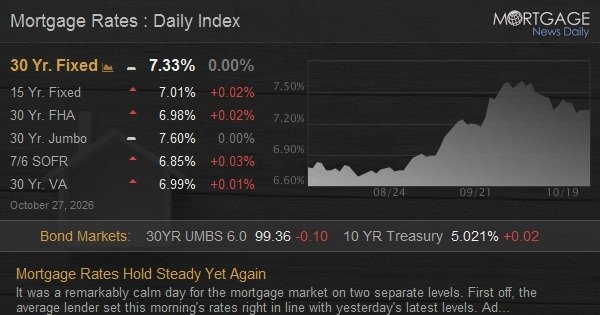
Mortgage rates entered an unusual stretch of calm this week, with the average lender keeping pricing essentially unchanged from the previous day. There were very few intraday adjustments, and when rates did move, the shifts were modest improvements. For anyone tracking home loan costs, the quiet session stood out because it followed several weeks of more volatile movement.
The stability traces directly to the bond market, which remained flat for a second consecutive day. Because mortgage rates generally follow bond yields, a steady bond market typically produces steady mortgage pricing. After recent turbulence, two days of consistency represent a noticeable change of pace for borrowers, lenders, and housing market observers.
Mortgage rates do not move in isolation. They generally track the direction of the broader bond market, which is why stability in Treasury yields often translates directly into steady pricing for home loans.
A Rare Stretch of Calm in Mortgage Pricing
Industry observers described the session as remarkably calm on two levels. First, most lenders established morning rates in line with the previous day’s levels rather than repricing higher or lower. Second, intraday changes were minimal, with any movement skewing toward slight improvement. That combination is not common during periods when economic data, geopolitical headlines, or central bank expectations are actively driving trading.
What made the steadiness possible was a bond market that refused to break away from the prior day’s range. For weeks leading up to this period, mortgage rates had been more reactive to shifting sentiment. The recent two-day pause suggests that, at least temporarily, the usual sources of market motivation have gone quiet.
Why the Bond Market Is Dictating Rate Stability
Mortgage rates are closely connected to bond market performance, particularly the yields on U.S. Treasury securities and mortgage-backed securities. When bond prices rise and yields fall, mortgage rates often follow downward. When bond prices fall and yields rise, mortgage rates typically move higher. In this case, bond yields remained anchored, leaving mortgage lenders little reason to adjust their rate sheets.
That stability matters because it offers a temporary window of predictability. Borrowers who locked in rates during this period were not chasing a moving target, and lenders were not issuing midday reprice notices. However, market calm should not be mistaken for a permanent trend. The same bond market that is holding steady today can react quickly tomorrow if new information arrives.
Federal Reserve Announcement Could Break the Quiet
The next major potential catalyst is the Federal Reserve’s latest policy announcement. Central bank decisions frequently introduce volatility into mortgage markets, and that volatility is not necessarily tied to whether the Fed raises, cuts, or holds its benchmark rate. Often, the market responds to the language in the Federal Open Market Committee statement and to the tone of the Federal Reserve Chair’s remarks during the subsequent press conference.
Even when a rate decision is widely anticipated, the central bank’s communication can shift investor expectations about inflation, economic growth, and the future path of interest rates. Those expectations influence bond yields, which in turn influence mortgage rates. For that reason, borrowers and loan officers are watching the Fed event closely to see whether the current period of stability will continue or give way to renewed movement.
Other Market Forces That Could Still Move Rates
Beyond the Federal Reserve, several other factors can influence bond trading and mortgage pricing. Technology sector volatility has at times driven investors toward or away from safer assets, including bonds. Geopolitical headlines related to war or international conflict can produce similar flights to safety. The challenge is that none of these forces operates on a predictable timetable.
Market participants describe the bond and rate environment as constantly at risk of responding to new sources of motivation. That means today’s steady rates could be disrupted by an economic report, a corporate earnings shock, or an unexpected global development. Borrowers should treat the current calm as a useful opportunity rather than a guarantee that rates will remain where they are.
What Borrowers Should Do During a Rate Pause
For prospective homebuyers and homeowners thinking about a refinance, a stable rate environment offers a chance to review options without the pressure of rapidly changing quotes. This can be a good time to compare lender offers, confirm rate lock terms, and make sure personal finances are ready for underwriting. It is also a reminder that mortgage pricing can shift quickly once the bond market reacts to new information.
Working with a knowledgeable loan officer can help borrowers understand how much risk they are comfortable taking if they choose to float a rate rather than lock it. Because mortgage rates are influenced by factors outside any individual’s control, preparation and timing often matter more than trying to predict the exact bottom of the market.
How Fed Policy Reaches Mortgage Rates
The Federal Reserve does not set mortgage rates directly. Instead, its policy decisions shape investor expectations, which move bond markets. When the Fed signals a tighter or looser monetary policy stance, bond traders adjust their positions, and those adjustments flow through to mortgage-backed securities and the rates lenders offer consumers. Monitoring Fed statements, inflation reports, and employment data can therefore provide useful context for anyone watching mortgage rate trends.
The current pause in mortgage rates is welcome news for borrowers, but it should not be mistaken for a permanent shift. A single policy statement, economic release, or global headline can change the bond market’s direction within minutes. Buyers and homeowners are best served by staying informed, communicating regularly with their lenders, and being ready to act when the right rate opportunity appears.
Business, Finance, Government, Home, News, Real Estate, Mortgage Rates, Federal Reserve, Housing Market, Home Loans, Interest Rates, Bond Market, Real Estate Finance, Borrowers, Economic Indicators, Market Stability


