

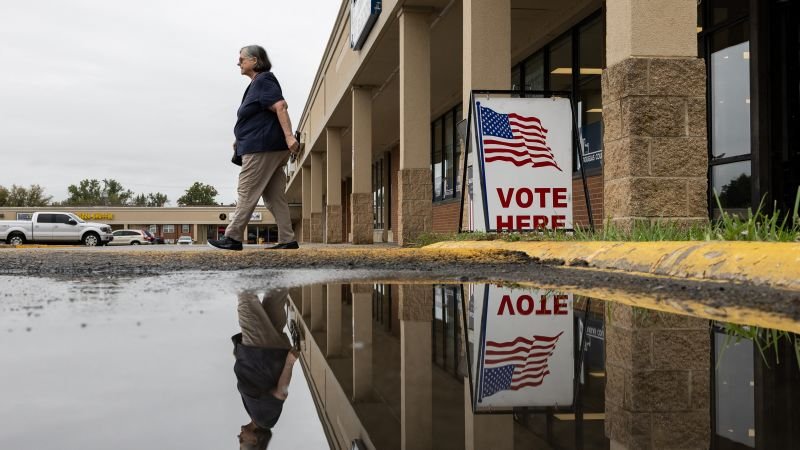

Election Day Weather: Central U.S. Storm System Threatened Voter Turnout in Key Midterm Races
A potent storm system tracked across the central United States on Election Day 2022, delivering widespread rain, gusty winds, and isolated severe thunderstorms to states hosting some of the most competitive midterm contests. While more than 43 million Americans had already cast ballots through early voting, the inclement conditions posed a tangible turnout factor for millions of remaining voters in pivotal battlegrounds including Iowa, Kansas, Michigan, and Texas.
Storm System Overview: A Broad Swath of Wet Weather
The low-pressure system generated a sprawling shield of precipitation stretching from the Great Lakes and Upper Midwest through the Plains and into the western Gulf Coast. Forecast models—including the American GFS and European ECMWF—consistently depicted a coherent rain band affecting the central corridor during peak voting hours. While flash flooding risk remained low, meteorologists warned of ponding on roadways and reduced visibility that could complicate travel to polling locations.
Wind emerged as a parallel concern, particularly across the Plains where pressure gradients tightened. Kansas faced sustained breezes with gusts reaching 30 to 40 mph, creating wind-driven rain that made conditions feel raw and discouraging for voters waiting in outdoor lines.
Battleground States in the Crosshairs
The storm’s precipitation shield overlapped uncomfortably with several high-stakes races. In Iowa, where Senator Chuck Grassley and Governor Kim Reynolds faced competitive challenges, rain covered much of the state with highs only in the 50s and 60s. Kansas contended with the most intense wind-driven rainfall in its central and eastern districts—areas critical to the gubernatorial and congressional contests.
Michigan saw its northern and western regions under steady rain, potentially affecting turnout in competitive House districts and the closely watched governor’s race between Gretchen Whitmer and Tudor Dixon. In Texas, the storm’s southern flank brought not just rain but a severe weather threat to eastern and coastal regions, including the Houston metro area.
Severe Thunderstorm Risk on the Southern Flank
The storm’s warm sector fueled a line of thunderstorms from eastern Texas through Arkansas, Louisiana, and into Mississippi. The Storm Prediction Center highlighted a risk of damaging wind gusts as the primary severe hazard, with isolated tornadoes not ruled out. For voters in Tyler, Longview, Shreveport, and surrounding communities, the combination of heavy downpours and severe warnings added urgency to timing their trip to the polls.
“Rainfall and other active weather tend to suppress voter turnout while sunshine has the opposite effect, multiple studies have found.”
Unseasonable Warmth Dominated the Eastern Half
Despite the storm, temperatures ran well above normal across most of the eastern United States. Highs ranged 5 to 20 degrees Fahrenheit above mid-November averages from the Plains to the East Coast. The Midwest and Great Lakes saw 60s and 70s instead of typical 40s and 50s, while the Southeast basked in 70s and low 80s. Only the Southwest trended slightly cooler than average—a pattern consistent with the amplified ridge-trough configuration driving the central storm.
State-by-State Forecast Breakdown
| State | Conditions | High Temperatures |
|---|---|---|
| Georgia | Likely dry | 70s to low 80s |
| Iowa | Rain likely; placement uncertain | 60s (50s northwest) |
| Kansas | Wind-driven rain central/east | 40s–50s NW; 60s–low 70s east |
| Maine | Possible showers north | 40s to low 50s |
| Michigan | Rain north/west | 50s UP; 60s Lower Michigan |
| New Hampshire | Nuisance showers possible north | 40s and 50s |
| North Carolina | Likely dry | 70s |
| Ohio | Dry (rain stays west) | 70s |
| Texas | Rain east/coast; severe storms possible | 80s coast; 60s panhandle |
The Research: Weather’s Measurable Impact on Turnout
Political scientists and meteorologists have long documented the correlation between Election Day weather and voter participation. A seminal 2007 study published in The Journal of Politics by Brad Gomez, Thomas Hansford, and George Krause found that rain reduces voter turnout by approximately 0.9% per inch, while snow decreases it by 0.5% per inch. The effect is asymmetric: Republican candidates historically benefit from lower turnout induced by bad weather, a pattern attributed to demographic differences in voting propensity and transportation access.
More recent analyses, including a 2020 study in Electoral Studies, confirm these findings while noting that early voting expansion has partially mitigated weather sensitivity. However, on Election Day itself, the marginal voter—often younger, lower-income, or less politically engaged—remains disproportionately deterred by precipitation and cold.
Early Voting Blunted but Didn’t Eliminate Weather Exposure
With over 43 million ballots cast before Election Day, the electorate’s exposure to weather risk was significantly reduced compared to previous cycles. States like Georgia, Texas, and Michigan saw record early turnout, particularly in urban and suburban counties. Yet millions of voters—especially in rural areas with fewer early voting locations—retained the Election Day tradition, leaving them vulnerable to the storm’s deterrent effect.
In Kansas and Iowa, where early voting windows are more limited, a larger share of the electorate faced the winds and rain head-on. The net partisan impact would depend on which party’s marginal voters were more likely to stay home—a calculation campaigns monitored closely through turnout modeling.
Final Perspective: Weather as a Silent Campaign Factor
The 2022 midterms demonstrated that despite advances in early voting and mail ballots, Mother Nature retains a vote of her own. The central U.S. storm system didn’t determine any single race outright, but in contests decided by thousands—or hundreds—of votes, the marginal suppression of turnout in rain-soaked precincts carried mathematical significance. As climate patterns shift toward more extreme precipitation events, the intersection of meteorology and democratic participation will only grow more relevant for campaigns, election administrators, and voters alike.
News, Government, Politics, Weather, Elections, Science, Society, United States, Iowa, Kansas, Michigan, Texas, Georgia, North Carolina, Ohio, Maine, New Hampshire, 2022 Midterms, Voter Turnout, Early Voting, Severe Weather, Climate, Transportation, Public Policy, Political Science, Meteorology, Campaigns, Voting Rights, Civic Engagement


