

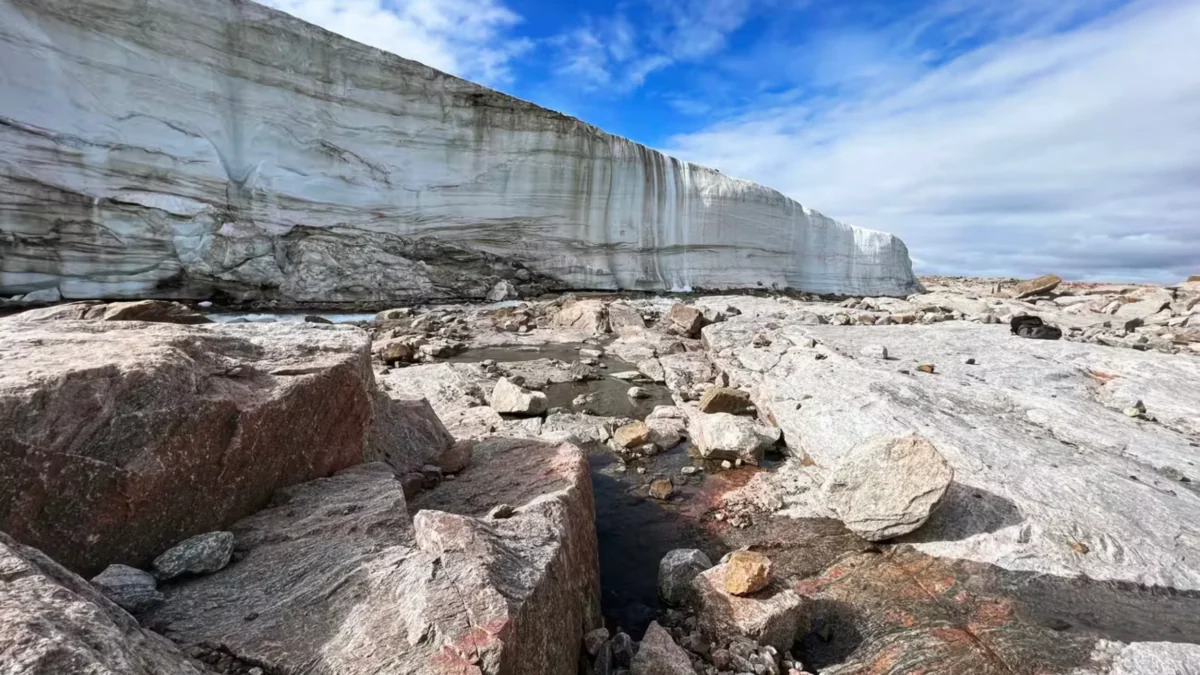

Human Activity May Have Interrupted the Next Ice Age, Study Suggests
Earth’s climate has swung between warmth and cold for millions of years, but a new analysis suggests that the planet was poised to enter a new glacial period roughly 2,000 years ago—only to be interrupted by the rising greenhouse gases of human civilization. The findings, published in Science, focus on the remnant of the once‑massive Laurentide Ice Sheet, the Barnes Ice Cap, and reconstruct its history using atomic clocks buried in rock and ancient plants.
The Study
Lead author Nicolás Young, a geochemist at Columbia University, and his team set out to determine when the Laurentide Ice Sheet began to retreat and when its successor, the Barnes Ice Cap, started to grow again. By dating exposed bedrock and preserved vegetation, they built a chronology that reveals the ice cap’s size over the last several thousand years.
“It was just getting started, everything was normal, the next glaciation was about to happen – and yet it stopped,” Young said.
Methods
The researchers employed two independent dating techniques. First, they measured the concentration of cosmogenic beryllium‑10 in rocks, an isotope produced when cosmic rays strike the surface. When ice covers the stone, the isotope stops accumulating; when the ice retreats, the build‑up resumes, providing a “stopwatch” for glacial advance and retreat. Second, they analyzed carbon‑14 in ancient plant remains uncovered by the melting ice. Because dead vegetation stops exchanging carbon with the atmosphere, the decay of carbon‑14 marks the moment the plants were buried by ice.
Timeline
The reconstructed timeline shows a surprising pattern. After the warmest part of the Holocene, roughly 11,000–10,000 years ago, the Laurentide Ice Sheet continued to shrink because its surface had become too low to sustain growth, even as the climate began to cool. By about 3,600 years ago the ice cap was smaller than it is today and remained at that minimum until approximately 2,000 years ago. It was then that the Barnes Ice Cap began to expand, marking the inception of a new glaciation.
| Period | Event | Approx. Years Ago |
|---|---|---|
| Early Holocene | Warmest interval | 11,000–10,000 |
| Mid‑Holocene | Ice cap shrinks to minimum | 3,600 |
| Late Holocene | Onset of expansion | 2,000 |
| 20th Century | Maximum extent (~1960) then rapid melt | ~60 |
Implications
The study indicates that the Barnes Ice Cap reached its greatest extent around 1960, just as anthropogenic greenhouse gas emissions began to accelerate. Since then, rising summer temperatures have caused the ice cap to lose mass faster than it can accumulate, a trend observed across other Arctic ice bodies. Under current emission scenarios, models project that the remnants of the Laurentide Ice Sheet will disappear entirely, erasing the last physical link to an ancient ice age.
Young concluded, “What has been an extremely natural and predictable phenomenon is now gone.” The research underscores how human activity can override long‑term orbital cycles that have historically paced Earth’s climate.
For now, scientists continue to monitor the Barnes Ice Cap as a sentinel of rapid change, while the public’s interest in the timing of the next ice age remains high, reflecting broader concerns about climate change.
Science, News, Climate change, Ice ages, Laurentide Ice Sheet, Barnes Ice Cap, Anthropogenic warming, Holocene, Pleistocene



