



The Twilight Zone Episode That Became “Real Steel”
The Twilight Zone would often turn to the great science fiction writers of the day to pen episodes for what is widely considered the best anthology series of all time. In particular, Richard Matheson was such a prolific writer that he ended up writing 16 episodes of the show, including popular titles like “Nightmare at 20,000 Feet” starring William Shatner. Matheson used a short story he had written for one of his episodes that worked so well it was expanded into a full-length movie starring Hugh Jackman years later.
That movie is “Real Steel.” But the original story, simply titled “Steel,” was a much darker affair. Here is how a 60-minute television story became a blockbuster film, and why Matheson’s influence on Hollywood sci-fi remains undeniable.
The Twilight Zone’s Favorite Sci-Fi Writer
During the original run of the CBS anthology series, Richard Matheson was a household name in science fiction circles. His output was staggering: not only did he contribute six episodes in the original five-season run, but he also wrote two episodes of the 1985 revival series. He bridged the gap between classic pulp magazine storytelling and the polished, character-driven TV drama of the 1960s.
When “Steel” was adapted from his short story, Matheson’s reputation allowed him creative latitude, but the television medium still demanded a contained narrative. A single episode had to establish a world, a conflict, and a resolution without the budget for a 90-minute production. What resulted was a tight, cynical fable about human desperation.
Stephanie Augello/Getty Images
The Dark Tale of “Steel”
“Steel” takes place in a future where human boxing has been banned and replaced with robot boxing. The story follows a former boxer who manages an outdated robot fighter. The robot is asked to fill in at the last minute, but is damaged beyond repair, so the human manager decides to pretend to be a robot and fight in its place.
The manager in the episode was played by Lee Marvin, one of the biggest movie stars to appear on the show. Predictably, the human is almost killed by his robot opponent and is only given half of the money he was promised since the fight was so one-sided.
In “The Twilight Zone,” the moral of the story is that humans will always optimistically take on challenges even if they are ultimately hopeless. While that worked for a single episode of television and short story, big changes had to be made when Hollywood and Hugh Jackman got involved.
How Hollywood Softened the Punch
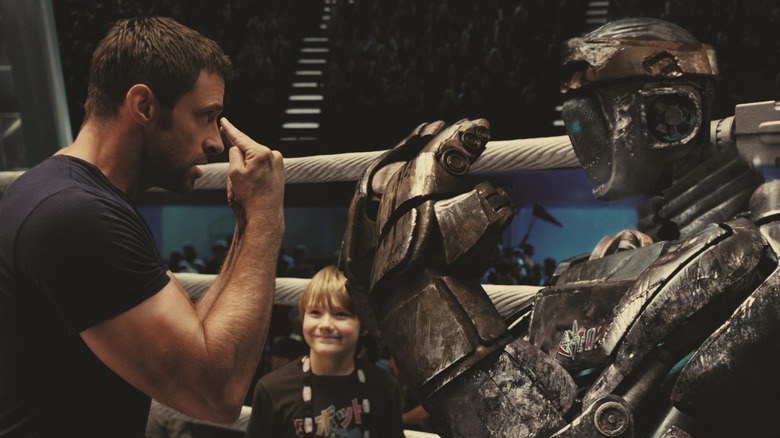
When the Richard Matheson short story “Steel” was turned into the major motion picture “Real Steel,” the tone was softened considerably. Hugh Jackman’s character never steps into the ring like Lee Marvin did. Instead, he just trains his robot to become a better fighter. The robot rises through the ranks and eventually takes down the undefeated champion, making for a much more sanitized and uplifting Hollywood ending compared to what Matheson wrote.
This change reflects a fundamental difference between 1960s television and modern blockbusters. The original story was a tragedy about a man losing everything; the film is an inspirational underdog story about a father rebuilding his relationship with his son through the sport of boxing. The robot, Atom, became a beloved character in his own right, replacing the cynical human gambit as the emotional center of the narrative.
Dreamworks
Matheson’s Blueprint for Modern Movies
This wouldn’t be the only time one of the sci-fi author’s stories got the big screen treatment. Matheson had built a unique ability to write concepts that could be expanded or reinterpreted across different media, a skill that made his work endlessly adaptable for directors seeking fresh premises.
Three Versions of a Legend
In 1954, he wrote his most popular work, “I Am Legend,” which would be made into a film on three separate occasions: once as “The Last Man on Earth” in 1964, again as “The Omega Man” in 1971, and finally as “I Am Legend” in 2007.
Each version interpreted the core concept differently—whether as a vampire story, a post-apocalyptic thriller, or a psychological drama—but they all retained Matheson’s premise of the last man on Earth battling an infection. This pattern demonstrates the enduring appeal of his ideas.
From Page to Screen: The Matheson Filmography
Beyond “Real Steel” and “I Am Legend,” Matheson’s short stories continued to fuel Hollywood for decades. His willingness to explore moral ambiguity and ethical dilemmas made his work ripe for adaptation.
| Source Material | Year | Adaptation | Medium |
|---|---|---|---|
| “Steel” | 1963 | The Twilight Zone (TV Episode) | Television |
| “Steel” | 2011 | Real Steel (Feature Film) | Cinema |
| “I Am Legend” | 1954 | The Last Man on Earth (1964) | Cinema |
| “I Am Legend” | 1971 | The Omega Man (1971) | Cinema |
| “I Am Legend” | 2007 | I Am Legend (2007) | Cinema |
| “Button, Button” | 1959 / 1985 | The Twilight Zone (TV Episode) | Television |
| “Button, Button” | 2009 | The Box (Feature Film) | Cinema |
Matheson would have one more short story turned into an episode of “The Twilight Zone,” as well, albeit for the underrated 1985 revival. “Button, Button” is about a poor couple given the chance to make $200,000 if they press a button that will kill a random stranger. The concept would later be adapted into the film “The Box” in 2009.
A Legacy That Never Folds
The transformation of “Steel” into “Real Steel” remains one of the clearest examples of how Matheson’s stories could be reshaped for different audiences. The core idea—a man against machines—remained intact, but the emotional arc shifted from cynical despair to hopeful triumph.
Today, “Real Steel” is celebrated not just for its robot choreography and 1980s-inspired boxing aesthetic, but as a testament to the source material’s flexibility. The film proved that Matheson’s dark fables could survive the Hollywood filter and still resonate with millions of viewers, cementing his status as one of the most influential writers in science fiction history.
Entertainment, Literature, Science, Sports, Arts, People, The Twilight Zone, Richard Matheson, Real Steel, Hugh Jackman, Sci-Fi Cinema, Hollywood History


