

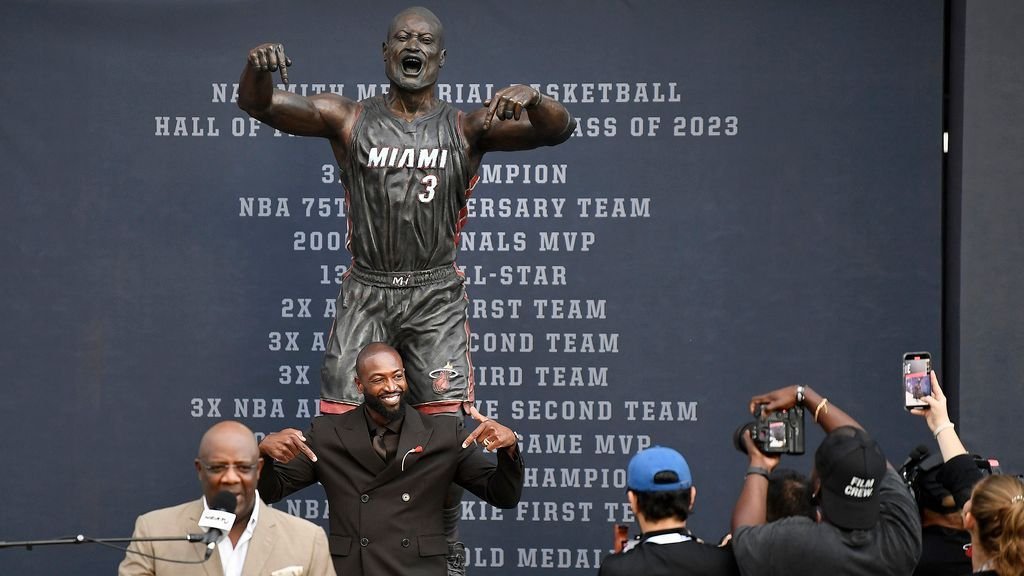

Dwyane Wade Updates His Miami Statue, Addresses Long-Standing Criticism
Miami, FL — In a move that underscores the power of public feedback and personal reflection, former NBA star Dwyane Wade has unveiled a revamped statue of himself outside the Kaseya Center in Miami, addressing widespread criticism of the original sculpture’s likeness. The update marks a significant moment in the intersection of sports legacy, community identity, and artistic representation.
The Original Statue’s Controversial Reception
The original statue, installed in 2023 to commemorate Wade’s contributions to the Miami Heat and his enshrinement in the Basketball Hall of Fame, drew immediate scrutiny from fans and critics alike. The sculpture, which depicted Wade in a celebratory pose following a 2009 game-winning shot, captured the energy of the moment but failed to accurately represent his facial features. Social media buzzed with comparisons to caricatures and memes, with many expressing disappointment that the artwork did not honor Wade’s legacy with the respect it deserved.
“The face didn’t look like Dwyane Wade at all,” one fan wrote on X. “It’s like they sculpted a ghost.”
Wade’s Response and the Decision to Revise
On Friday, Wade released an essay detailing his rationale for the statue’s overhaul. “I had to ask myself a pretty simple question: ‘If people don’t feel that connection when they look at the face, why wouldn’t we try to make it better?’” he wrote. The NBA legend emphasized that the decision to revise the sculpture was not a rejection of artistic vision but a commitment to authenticity and community resonance.
“This isn’t about erasing the work that was already done or disrespecting the artists who put their time and talent into creating it. It’s about being willing to listen,” Wade continued. “It’s about recognizing when something carries meaning for more people than just yourself and being open enough to revisit it.”
The Moment Preserved: From Courtside to Community
The statue’s pose is inspired by March 15, 2009, when Wade hit a buzzer-beating three-pointer to force double overtime against the Chicago Bulls. After the game, he climbed onto a courtside table, declaring, “This is my house.” The scene became a defining image of Wade’s tenure with the Heat and his deep connection to Miami’s fanbase. The original sculpture captured the dynamism of the celebration but, in Wade’s words, failed to reflect “the face of the city.”
“The 305 deserves to look at that statue and feel the same energy it felt that night,” Wade wrote, referencing Miami’s area code. “And the fans deserve to see themselves in that moment because their noise, their belief, and their love were part of what made it possible.”
Visualizing the New Legacy
Over the past week, sculptors and designers worked quietly on the statue’s facial reconstruction, concealing the changes behind a plywood enclosure until the reveal. The Miami Heat shared before-and-after images on social media, showcasing a more accurate portrayal that balances artistic interpretation with recognizable detail.
“When people see it now, they see a better likeness of me. But more than that, I hope they see themselves,” Wade concluded. “Because it may be my likeness, but it will always be our house.”
Broader Implications for Sports Art and Community Engagement
Wade’s decision to revise the statue reflects a growing trend in public art: the demand for authenticity and inclusive storytelling. From critiques of statue inaccuracies to debates over whose stories are honored in public spaces, the moment highlights how communities increasingly view these works as extensions of lived experience. For Miami, the statue is not just a tribute to an athlete but a symbol of collective pride and resilience.
As the city prepares to embrace the updated artwork, one message remains clear—Wade’s legacy is intertwined with Miami’s identity, and his willingness to listen ensures that the tribute will resonate for generations to come.
Categories
Sports, Miami, People, Entertainment, Society, Real Estate


