

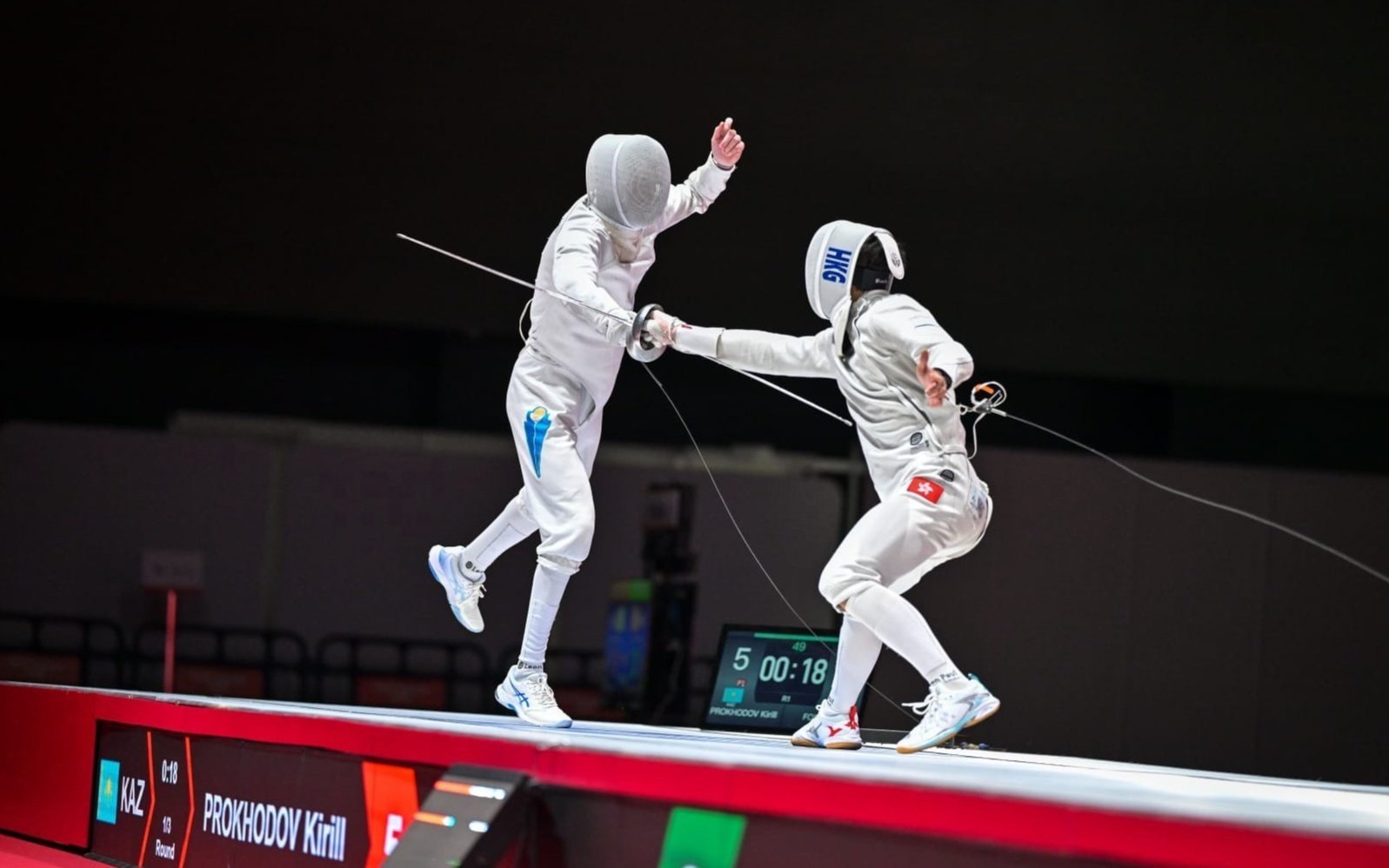

Kazakhstan Claims Three Medals at Asian Fencing Championships as Prokhodov Strikes Gold in Men’s Épée
Kazakhstan’s fencers delivered a standout performance at the Asian Fencing Championships, securing a trio of medals highlighted by Kirill Prokhodov‘s commanding gold medal victory in the men’s individual épée competition. The championship, held in Kuwait City from June 22–27, 2024, saw the Central Asian nation finish with one gold, one silver, and one bronze medal, reinforcing its rising status in continental fencing.
Prokhodov Dominates Men’s Épée Final
Kirill Prokhodov captured Kazakhstan’s lone gold medal with a composed 15-12 victory over Hong Kong’s Wong Pak-yiu in the men’s individual épée final. The Kazakh fencer controlled the bout from the outset, building an early lead and maintaining tactical discipline against his Hong Kong opponent. Prokhodov’s path to the final included victories over top-seeded competitors from Japan and South Korea, signaling his emergence as a continental force in the discipline.
The 26-year-old’s triumph marks Kazakhstan’s first men’s individual épée gold at the Asian Championships since 2019 and adds a significant individual accolade to a résumé that already includes team success on the world stage. Prokhodov credited his coaching staff’s video analysis of Wong’s timing patterns for the strategic edge in the final.
Zhanybek and Issabekova Complete Sabre Medal Haul
In the women’s sabre competition, Kazakhstan secured both silver and bronze medals. Kaisha Zhanybek advanced to the final before falling 15-8 to Hong Kong’s Summer Jane Sit, who claimed her second consecutive Asian Championships gold in the event. Zhanybek, 24, reached the final with a dramatic 15-14 semifinal victory over Uzbekistan’s Zaynab Dayibekova, showcasing resilience under pressure.
Dilyara Issabekova earned the bronze medal after a strong tournament run that ended in the semifinals against Sit. The 22-year-old’s podium finish continues her progression following a breakthrough 2023 season that included a World Cup podium in Sint-Niklaas, Belgium. Kazakhstan’s two-medal haul in women’s sabre underscores the program’s depth in the discipline.
Historic World Ranking Achievement Provides Context
The championship medals arrive weeks after Kazakhstan’s men’s épée team reached the summit of the FIE world rankings for the first time in history, a milestone announced by the Kazakhstan Fencing Federation in May 2024. The team, anchored by Prokhodov alongside Elmir Alimzhanov, Ruslan Kurbanov, and Vadim Sharlaimov, accumulated consistent World Cup and Grand Prix results over the 2023-24 season to displace traditional powers France and Italy.
Ranking Context: Kazakhstan’s rise to No. 1 in men’s team épée reflects a systematic investment in coaching, sports science, and international competition exposure since 2018. The team’s ranking points lead over second-place France stands at 32 points as of the June 2024 FIE update.
This historic ranking achievement provided psychological momentum for the Asian Championships, where the individual events serve as critical preparation for the Paris 2024 Olympic Games. Prokhodov’s gold validates the team’s world No. 1 status at the individual level.
Olympic Implications and Paris 2024 Outlook
With the Paris Olympics approaching in July, the Asian Championships served as a final major benchmark for Kazakh fencers. Prokhodov has already secured his individual Olympic quota place via the FIE ranking pathway, while the men’s épée team qualified through their world No. 1 ranking. In women’s sabre, Zhanybek and Issabekova are competing for Kazakhstan’s two available quota spots, with the final allocation determined by the FIE official ranking as of April 2024.
Kazakhstan’s fencing federation has targeted a historic medal breakthrough in Paris. The nation has never won an Olympic fencing medal; its best result remains a fourth-place finish by the men’s épée team at Tokyo 2020. The current cohort’s blend of experienced veterans and emerging talents represents the deepest Kazakh fencing delegation in Olympic history.
Regional Rivalry with Hong Kong Intensifies
The finals in both men’s épée and women’s sabre pitted Kazakhstan against Hong Kong, highlighting a growing rivalry between the two Asian fencing powers. Hong Kong’s Summer Jane Sit defended her women’s sabre title, while Wong Pak-yiu’s silver in men’s épée adds to Hong Kong’s strong championship showing. The territory finished the competition with three gold medals overall, topping the medal table ahead of Japan and South Korea.
This competitive dynamic benefits both programs. Hong Kong’s professional league structure and Kazakhstan’s centralized sports institute model represent contrasting development pathways producing elite results. Their head-to-head encounters in Kuwait City featured tactical sophistication rarely seen at continental championships a decade ago.
Development Pipeline and Future Prospects
Beyond the senior medals, Kazakhstan’s junior fencers impressed in the concurrent Asian Junior and Cadet Championships. The men’s junior épée team captured gold, while 17-year-old Aruuke Tulegenova reached the women’s sabre semifinals. These results validate the federation’s long-term athlete development strategy, which integrates sports science support from the National Olympic Committee’s High Performance Center in Almaty.
Investment in foreign coaching expertise has also paid dividends. Italian maestro Paolo Milanoli, hired as men’s épée head coach in 2021, implemented a systematic approach emphasizing video analytics, periodized physical preparation, and simulated pressure scenarios. French sabre specialist Julien Pillet joined the women’s program in 2022, introducing tactical frameworks that have elevated Kazakhstan’s sabreurs to consistent World Cup finalists.
Conclusion: A Defining Moment for Kazakh Fencing
Kazakhstan’s three-medal performance at the Asian Fencing Championships, crowned by Kirill Prokhodov’s gold and reinforced by a historic world No. 1 ranking in men’s team épée, marks a defining moment for the sport in Central Asia. The results reflect a decade of strategic investment, coaching excellence, and athlete development that has transformed Kazakhstan from a regional participant into a continental powerhouse with legitimate Olympic medal aspirations.
As the Paris Games approach, the Kazakh delegation carries momentum, depth, and a proven ability to perform under pressure. Whether that translates to an historic first Olympic fencing medal will depend on execution in July, but the foundation has been unequivocally established. For now, Kazakhstan stands atop Asian fencing — a position earned through systematic excellence rather than fleeting success.
News, Sports, Kazakhstan, Fencing, Asian Fencing Championships, Kirill Prokhodov, Kaisha Zhanybek, Dilyara Issabekova, Paris 2024 Olympics, FIE World Rankings, Men’s Épée, Women’s Sabre, Hong Kong Fencing, Summer Jane Sit, Wong Pak-yiu, Sports Development, Olympic Qualification, Central Asia Sports


