

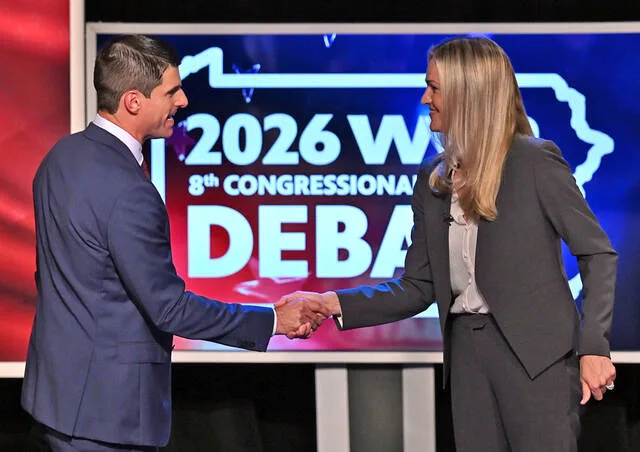

Bresnahan and Cognetti Face Off in Sole Congressional Debate Before November Election
PITTSTON — In the only scheduled face-to-face meeting before voters head to the polls this November, Republican incumbent U.S. Rep. Rob Bresnahan Jr. and Democratic challenger Paige Cognetti, the mayor of Scranton, squared off Thursday night at the WVIA Public Media Studios. The hour-long debate offered the 8th Congressional District’s electorate a direct, unfiltered look at two candidates presenting starkly different visions for the region’s future in Washington.
Moderated by veteran broadcaster Tracey Matisak alongside a panel of journalists — Borys Krawczeniuk (WVIA News), Michael P. Buffer (The Citizens’ Voice), and Francine Schertzer (PCN) — the event unfolded before a live studio audience. With control of the 120th Congress hanging in the balance, the stakes extended well beyond district lines.
Economy, Affordability, and the Cost of Living Dominate Exchange
From the opening minutes, the candidates clashed over the kitchen-table issues animating the race. Bresnahan, a Dallas Township resident serving his first term, anchored his defense in a record he said reflects the priorities of Northeastern Pennsylvania families. He pointed to votes aimed at reining in federal spending and opposing tax increases.
Cognetti, drawing on her executive experience steering Scranton out of Act 47 financially distressed status, countered that her opponent’s voting record tells a different story. She highlighted votes she characterized as supporting Medicare cuts, delivering tax breaks disproportionately benefiting the wealthiest Americans, and backing tariffs that she argued raise prices on everyday goods. The mayor repeatedly linked foreign policy expenditures — specifically funding for the conflict involving Iran — to domestic affordability, arguing that dollars spent abroad are dollars not invested in lowering costs at home.
Foreign Policy Fault Lines: Iran, Ukraine, and Diplomatic Strategy
The sharpest policy divergences emerged on the international stage. On Iran, Bresahan declared that a regime chanting “Death to America” must never obtain a nuclear weapon. He acknowledged voting six times to fund the conflict but framed those votes as necessary to prevent a nuclear-armed adversary. Cognetti challenged the sustainability of open-ended military commitments without clear exit strategies, tying the financial burden directly to the inflationary pressures facing her constituents.
On Russia’s war in Ukraine, both candidates condemned Vladimir Putin and expressed support for Ukraine’s sovereignty. Bresnahan advocated for a diplomatic resolution to the years-long conflict, while Cognetti emphasized the need for accountability and sustained support for democratic allies. The overlap revealed a rare bipartisan consensus on the threat posed by Russian aggression, even as their preferred tactical approaches differed.
Stock Trading, Ethics, and the Trust Deficit
The controversy surrounding congressional stock trading surfaced as a flashpoint. Bresnahan insisted he has never directed his financial advisers on specific trades, maintaining that his investments are managed independently. Cognetti seized on the broader issue, calling for stricter ethics rules and a ban on individual stock ownership by members of Congress — a position that has gained traction in recent cycles but faces institutional resistance.
The exchange underscored a pervasive voter skepticism toward elected officials’ financial dealings, a sentiment both candidates acknowledged but addressed through different lenses: one defending personal compliance, the other demanding structural reform.
Data Centers, Local Control, and Community Voice
A distinctly regional issue — the proliferation of data centers across Northeastern Pennsylvania — drew detailed responses. Bresnahan argued that host communities should hold the decisive voice in approval processes, emphasizing local zoning authority and community input. Cognetti, referencing her direct experience at municipal meetings in Scranton, stressed the infrastructure strain, water consumption, and noise concerns that accompany such developments, advocating for comprehensive regional planning rather than piecemeal approvals.
The debate highlighted a growing tension in the district between economic development ambitions and quality-of-life preservation, a dynamic likely to persist regardless of the election’s outcome.
Common Ground: Dark Money and Campaign Fatigue
In a striking moment of accord, both candidates denounced the flood of dark money and outside spending saturating the race. Cognetti called for an end to unlimited, undisclosed contributions, singling out billionaire donors — including Elon Musk — whose spending she argued distorts democratic accountability. Bresnahan echoed the frustration, citing the relentless barrage of mailers and advertisements clogging voters’ mailboxes and airwaves.
“Election Day will mark the end of all those ads and mailers,” Cognetti noted, to which Bresnahan readily agreed. The shared exasperation offered a rare glimpse of bipartisan consensus on campaign finance reform, even as both campaigns benefit from the very structures they criticized.
What the Numbers Show: A Toss-Up Race in a Pivotal Year
Public polling has consistently rated the contest as a toss-up, reflective of a district that has swung between parties in recent cycles. Republicans currently hold majorities in both the House of Representatives and the Senate, while Democrats are mounting a concerted effort to reclaim the balance of power. All 435 House seats and 35 Senate seats are on the ballot this November.
As the only scheduled debate, Thursday’s encounter carried outsized weight for undecided voters. Political observers noted the candidates’ general restraint — avoiding personal attacks while drawing clear policy contrasts — a tone that may reflect the district’s appetite for substance over spectacle.
Context: The 8th Congressional District encompasses Lackawanna, Luzerne, and parts of surrounding counties — a region with deep working-class roots, a growing logistics and healthcare economy, and a electorate that has proven decisive in statewide and national elections.
Looking Ahead: Six Weeks to Election Day
With the debate concluded, the campaign enters its final, most intensive phase. Both candidates will barnstorm the district, court absentee and early voters, and deploy the advertising arsenals they mutually lamented. The race’s outcome may hinge less on Thursday’s performance than on which candidate’s ground game turns out their base in a midterm environment shaped by presidential approval ratings, economic sentiment, and the unpredictable currents of national politics.
For voters, the choice crystallizes around competing theories of representation: Bresnahan’s argument that his incumbency and committee assignments deliver tangible results for the district, versus Cognetti’s case that her executive track record in Scranton translates to effective governance in a divided Washington.
| Debate Details | Information |
|---|---|
| Participants | Rep. Rob Bresnahan Jr. (R) vs. Mayor Paige Cognetti (D) |
| Date & Location | Thursday, WVIA Public Media Studios, Pittston |
| Moderator | Tracey Matisak |
| Panelists | Borys Krawczeniuk, Michael P. Buffer, Francine Schertzer |
| Election Date | Tuesday, November 3, 2026 |
| Significance | Only scheduled face-to-face debate |
The Verdict Is Now the Voters’
Thursday night’s debate did not produce a knockout moment, nor was it designed to. It provided something more durable: a side-by-side comparison of records, rhetoric, and readiness. The candidates’ disagreements were substantive; their agreement on campaign finance was notable. What remains is the work of citizenship — sifting through the claims, weighing the records, and casting a ballot on November 3.
In a district that has sent both parties to Congress in recent years, the final argument belongs not to the candidates, but to the electorate.
News, Politics, Government, Elections, Pennsylvania, Luzerne County, Lackawanna County, Scranton, Pittston, Rob Bresnahan, Paige Cognetti, US House, 8th Congressional District, WVIA, Debate, 2026 Election, Campaign Finance, Dark Money, Iran, Ukraine, Russia, Data Centers, Stock Trading, Medicare, Social Security, Tariffs, Bipartisan, Toss-Up Race


