

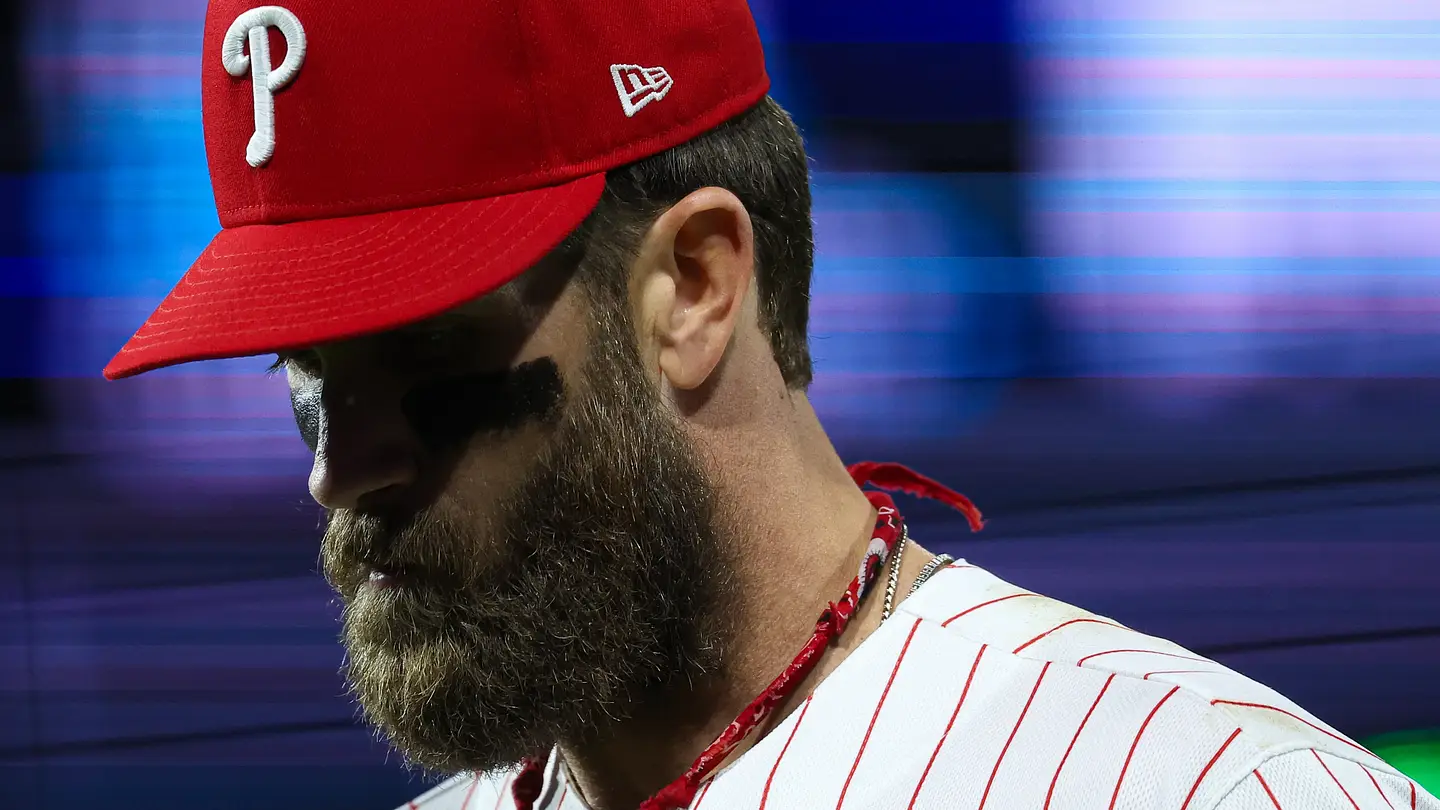

Phillies at a Crossroads: Examining the Bryce Harper Trade Scenarios That Could Reshape the Franchise
The Philadelphia Phillies enter the 2024-25 offseason at a franchise-defining inflection point. After a second consecutive NLDS exit — this time at the hands of the New York Mets — the organization faces uncomfortable questions about a core that has delivered regular-season excellence but postseason frustration. President of Baseball Operations Dave Dombrowski has built a win-now roster around expensive, aging stars, yet the championship window appears to be narrowing. Into this uncertainty steps the most radical possibility of all: trading Bryce Harper.
The Harper Contract Reality: Leverage, Limitations, and a No-Trade Clause
Harper signed a 13-year, $330 million free-agent deal in 2019, a contract that shook the baseball world. Five years and roughly $125 million remain on that commitment, carrying him through his age-38 season at a $25 million average annual value. By current market standards, that AAV represents a relative bargain for a player of Harper’s caliber — a two-time NL MVP who posted a .888 OPS with 30 home runs in 2024 despite playing primarily at first base.
However, two significant obstacles complicate any trade construction. First, Harper holds a full no-trade clause, meaning he controls his destination. Second, The Athletic’s Ken Rosenthal reported in early October that Harper would likely only waive that clause if the acquiring team extends his contract into his early 40s — a proposition the Phillies understandably resist. Any deal requires a “perfect confluence of circumstances”: a team with financial capacity, competitive appeal, geographical or personal appeal to Harper, and willingness to absorb long-term risk.
What Philadelphia Must Demand in Return
If the Phillies move their franchise face, the return must address three organizational pillars simultaneously:
- Major-league ready talent — ideally a right-handed bat to balance a lefty-heavy lineup
- High-upside prospect capital — to replenish a farm system depleted by win-now trades
- Payroll flexibility — to address a bullpen that collapsed in October and a roster top-heavy with nine-figure commitments
Reports suggest friction between Harper and the front office has grown, stemming from roster construction decisions and the team’s failure to supplement the core adequately. A trade could theoretically benefit both parties: Harper joins a club committed to him long-term, while Philadelphia gains the flexibility to rebuild around a younger, more balanced core.
Six Potential Destinations: Fit, Finance, and Feasibility
New York Yankees: The Bronx Spotlight
On paper, the fit is messy. The Yankees boast Aaron Judge in right field, Giancarlo Stanton entrenched at DH for 2025, and multiple first-base options. Yet the Yankees are perpetually in the mix for stars, and Stanton’s future remains uncertain. If New York moves Stanton — an increasingly discussed scenario — Harper could split time between right field and DH alongside Judge. Harper’s makeup suggests he could thrive under the Bronx microscope, but the roster congestion makes this a low-probability, high-intrigue scenario.
Boston Red Sox: Fenway’s Left-Field Lure
Boston possesses the financial muscle, market cachet, and competitive urgency to pursue Harper. His left-handed swing profile would feast on the Green Monster. The primary hurdle: an outfield logjam featuring Jarren Duran, Wilyer Abreu, and Ceddanne Rafaela that blocks the DH spot. If the Red Sox clear a path — perhaps by moving Masataka Yoshida — Harper becomes a compelling bridge to their next competitive window in a brutal AL East.
Athletics: The Las Vegas Homecoming
This is the most personally resonant destination. Harper grew up in Las Vegas; the Athletics relocate there in 2025. His $25 million AAV is a bargain for a franchise desperate for star power to launch a new market. Practically, Harper would share first base and DH duties with top prospect Nick Kurtz. Oakland’s greater need is pitching, but Harper transforms a lineup overnight and sells tickets. The question is ownership willingness to commit long-term dollars to a 32-year-old on a team still building its foundation.
Texas Rangers: Win-Now in a Weak Division
“Harper feels like a Texas Ranger,” as the source material notes. The Rangers’ 2023 World Series core — Corey Seager, Marcus Semien, Jacob deGrom — is aging, and the 2024 season exposed roster cracks. The AL West remains winnable. Harper adds immediate thunder to a lineup that faded down the stretch. However, this trade does not reset Texas’s timeline; it doubles down on a veteran core approaching its twilight. The Rangers must decide whether one final push justifies the long-term commitment.
Arizona Diamondbacks: The Cleanest Baseball Fit
On pure roster construction grounds, Arizona may be the best match. First base was a black hole for the Diamondbacks in 2024. They are a legitimate contender — one or two pieces from a deep October run — and carry a competitive payroll. Phoenix’s climate appeals to players. Recent postseason history between the clubs (Arizona eliminated Philadelphia in the 2023 NLCS) adds spice but shouldn’t deter a baseball operations group focused on winning. If Arizona views Harper as the final piece, the pieces align.
Seattle Mariners: West Coast Reset
Seattle mirrors Philadelphia’s predicament: elite pitching, disappointing offense, a wide-open division (AL West), and pressure to maximize a prime window. Julio Rodríguez and Cal Raleigh suffered career-worst seasons in 2024; bounce-back candidates abound. Harper would primarily DH, maximizing plate appearances while sparing his legs. The Mariners have prospect depth and a front office unafraid of bold moves. Geography works — Harper returns to the West Coast. The obstacle remains Seattle’s historical payroll conservatism.
Case Study: The Yankees Package — High Ceiling, High Variance
Among discussed frameworks, a New York-centric package centered on Spencer Jones and Carlos Lagrange illustrates the dilemma. Jones, a 6’7″ lefty slugger with 30-homer/20-steal upside, embodies the tools that excite scouts. He also struck out at a 30%+ clip in Double-A, raising contact concerns. For a Phillies team already plagued by left-handed strikeout heaviness, adding another boom-or-bust lefty bat may not solve the core problem.
Lagrange, a hard-throwing righty with triple-digit velocity and wipeout secondaries, missed 2024 with a shoulder injury. Command issues project him as a future high-leverage reliever rather than a frontline starter. For a Harper-caliber return, Philadelphia likely demands more than a potential Jhoan Durán-type setup man.
The steadiest asset in the hypothetical package is Heliot Ramos — a right-handed hitter with a .907 OPS vs. lefties in 2024, under club control through 2029. He solves an immediate Philadelphia weakness (righty platoon bat) but lacks star upside. The Phillies would be betting on Jones or Lagrange hitting their ceiling to justify moving a franchise icon.
The Decision That Defines an Era
Trading Bryce Harper would signal the end of the Dombrowski-era “win now at all costs” philosophy and the beginning of a painful but necessary transition. Keeping him — and spending to fix the bullpen, add a righty bat, and hope the core ages gracefully — represents a bet on continuity that has twice fallen short in October.
Harper’s no-trade clause makes him the ultimate gatekeeper. He can force the Phillies’ hand by refusing to waive it, or he can embrace a fresh start in a city that offers both contention and a long-term home. The front office must decide whether the greatest player in franchise history (aside from Mike Schmidt) is the cornerstone of the next contender or the asset that builds it.
Either path carries risk. The only certainty: standing pat is no longer an option. The Phillies’ next move — whether it involves Harper or not — will echo through Citizens Bank Park for the next decade.
Sports, Baseball, MLB, Philadelphia Phillies, Bryce Harper, Trade Rumors, MLB Offseason, Dave Dombrowski, New York Yankees, Boston Red Sox, Athletics, Texas Rangers, Arizona Diamondbacks, Seattle Mariners, Ken Rosenthal, Spencer Jones, Carlos Lagrange, Heliot Ramos, Free Agency, Contract Analysis, NL East, AL East, AL West, NL West, Franchise Cornerstone, No-Trade Clause, Payroll Flexibility, Prospect Evaluation, Competitive Window, Sports Business, Baseball Operations, Roster Construction, Postseason Disappointment, Organizational Strategy


