
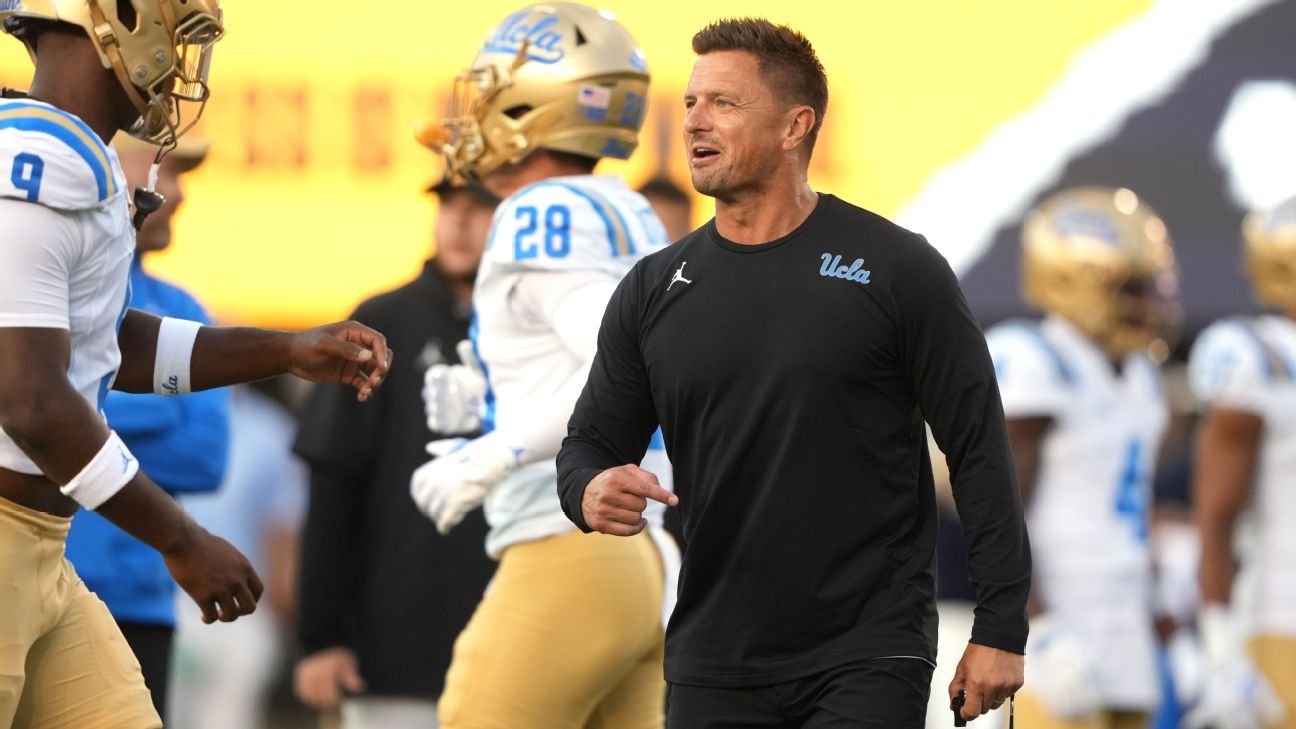


Bob Chesney’s Pre-Dawn Blueprint: How the UCLA Bruins Are Rewriting Their Identity
LOS ANGELES — Just after 6 a.m., before the sun is anything but a slight orange glow breaking through the moonlit Westwood sky, Bob Chesney is already on, roaring to go.
He emerges from the elevator at UCLA’s football facility wide-eyed, his voice already at decibels most people would reserve for daylight hours, and heads to the nearby campus tennis stadium. On Tuesday mornings, he reserves a sliver of time to run up and down the steep steps. Everything else, Chesney says, is football.
By 7 a.m., he is back inside, trading his running shoes for flip-flops. His hair is carefully coiffed, and as he stands behind a table inside the auditorium where the entire team meets, he bobs his head to the rhythm of 50 Cent’s “Many Men (Wish Death)” as if he were a DJ spinning his best mix.
On this particular Tuesday morning, the room is vibrating. Thirteen months after starting last season 0-3 and firing DeShaun Foster as head coach, UCLA is 4-0 and ranked No. 21 in the nation under Chesney. The program is nearly unrecognizable from its previous iteration, flying high while the man standing at the front of the room appears to possess the energy required to levitate.
“The second half of this season starts right now, eight [weeks] are done,” Chesney says, his voice growing louder. “There’s eight more coming up here. Just like you committed on Day 1 of camp, this is about a recommitment today.”
The meeting is a tone-setter for the day, the week, and the next opponent, which in this case is Oregon — the toughest team UCLA has faced to date. But it is also where Chesney’s coaching style comes into full view, a style that has produced a 136-52 overall record and eight conference titles across five programs.
6:00 a.m. and the Pre-Dawn Standard at UCLA
Once the morning meeting concludes, players break off into position groups. Chesney hangs back with the special teams group where his longtime coach-in-crime Drew Canan, UCLA’s assistant coach who oversees special teams and tight ends, rattles off assignments for players and reviews game planning with the same relentless cadence. The two have been working together since he joined Chesney’s 2014 staff at Assumption University in Massachusetts.
“I don’t think there’s a better person who can change a culture as he does,” Canan said.
Canan recalls one Saturday practice during spring camp when the energy and effort from start to finish was impressive. Equally notable was the way players were not just in sync with Chesney’s vision, but enjoying being part of it.
“It brought me back to the early days at Holy Cross, it brought me back to last year at James Madison,” Canan said. “It was the seventh or eighth practice we had [at UCLA] and I remember walking off the field and saying, ‘He did it again. We’ve got it.'”
In this room, everything feels as if it’s being run at twice the speed, as if the hurry-up offense the Bruins might utilize on the field has relocated indoors. Players sit with notebooks scribbling while Chesney flips through slides containing both broad mantras and hyper-specific game-plan tasks. He calls out a position group and on cue, each respective coach begins his spiel — often expletive-laden — that is part information, part motivation.
“You will do what you have to do to win the game. That’s done. That’s not a debate. That’s a f—ing fact,” he says. “I’m worried about how can you mentally take yourself to a different standard, hold yourself to that standard and never f—ing waver from it. That’s the question. How do I make that unbreakable? How do I bury my f—ing fracture point?”
Building on a JMU Foundation: Transplanting Success to the West Coast
About 10 months ago, after Chesney had taken the job and hired his staff, UCLA held a unique recruiting visit day. Every player who arrived in Westwood that day was coming from JMU, including running back Wayne Knight. After checking off their top priority of securing Nico Iamaleava’s commitment, Chesney, alongside new general manager Darrick Yray, shifted to the next important task: convince a group of JMU players who spent one season with Chesney that UCLA should be the next stop in their college careers.
There was one issue. It was one of the handful of days in Los Angeles on which rain was in the forecast.
“These guys had been hearing all about how great L.A. was and the weather and they get this?” Yray said with a laugh. The former Florida State GM with West Coast ties had already bought into Chesney’s vision when he turned down a multiyear contract to stay in Tallahassee.
That Chesney & Co. have been able to generate as much excitement about the program and early success is inextricable from the fact that they were able to mobilize the foundation they had at James Madison westward. All told, 28 staff members and 11 players from JMU followed Chesney.
“That’s a lot of people that are speaking the same language from day one. It allows you to catapult your success a lot quicker in theory,” said Matt Transue, the program’s chief of staff by way of JMU. “It has definitely helped, especially early on when we were resetting the culture here. Now everybody’s bought in.”
Signs of the Dukes’ influence and Chesney’s ethos from his first coaching job are everywhere. The practice structure is essentially the same one he has used at previous stops. Walk through the weight room and you’ll see a commemorative JMU weight plate hanging in one of the strength staff’s offices. The PowerPoint slide of “core principles” that Chesney used at Assumption, Holy Cross, and JMU is the same one he used during his first team meetings in January at UCLA.
| Metric | Detail |
|---|---|
| Staff Transfer from JMU | 28 staff members |
| Player Transfer from JMU | 11 players |
| Head Coach Contract | Five years, $33.75 million |
| Career Record | 136-52 overall, eight conference titles |
“I think the awe factor for all of us that came from James Madison was, ‘How has this place not won at a high level?'” Transue said. “The first day we got here, we were like, ‘Holy cow, this is unbelievable.’ I think that appreciation too is a lot of our coaches are from lower levels. They follow Chesney from Division III all the way through. So this is a big-time opportunity and they’ve already won with far less than what they have here now.”
9:15 a.m. on the Practice Turf: High Velocity and Shared Purpose
IT’S 9:15 A.M. WHEN Chesney takes the party outside. The Bruins pour out onto the practice field, which on this scorching day in L.A., is punishing anyone who dares to step on its unforgiving turf with temperatures in the mid-90s. Much like the meeting inside, UCLA’s practice has an almost frenetic pace where no second feels unaccounted for. Chesney is a human rubber band, stretching himself in every direction.
A moment with the first-team offense, which during this week has put loud speakers just behind their huddle to mimic the noise expected to be heard in Eugene on Saturday, one that the JMU contingent is quite familiar with from their CFP loss to Oregon last season. A check-in on the defensive backs, a quick Facetime with a recruit during stretching, a low-crouch in front of the defensive linemen to study their pass-rush technique and suddenly a loud whistle followed by an even louder yell.
“One up-down!”
The entire team echoes Chesney’s remark in unison and drops to the ground. “Special!” he says, signaling a transition to special teams. “You f—ing do that s—!”
Hang around the practice long enough and you start to hear another voice breaking through the music. It is older, but no less menacing than Chesney’s. “Knock him down! Put him on his ass!” Bob Sr., Chesney’s dad and a volunteer assistant for the Bruins, tells a lineman.
As the two orbit the practice field, one can capture just how far the apple fell from the tree. The answer? Not far, yet enough to where 76-year-old Bob Sr. can recognize that his son — “Bobby” as he calls him — had something unique from an early age.
“Even as a kid, you could see that leadership quality in him. All the kids gravitated toward him, whatever game they played, he was in charge,” Bob Sr. said.
Family Roots and the Bob Sr. Factor
And so the elder Chesney found himself gravitating to his son as well. When Chesney got his first head coaching gig at Salve Regina, a Division III school in Newport, Rhode Island, Bob Sr. — a longtime high school coach with a few stints at the college level — came along for the ride. He has been at every stop since, roaming practices, helping the rest of the staff, and keeping an eye on his son’s rise.
“I think if you just look at the total person, Bobby, you look at his total package that he’s selling, it certainly would fit at every level. And so far you have seen it has fit at every level,” Bob Sr. said. “He started at the lowest of lows, worked his way up telling the same story, improving it, spit-shining it a little bit as you move on. When you can afford a little more, the better polish, you can polish it a little bit better. And so right now the shoes are shining.”
There is an unmistakable energy about Chesney that feels incongruous or at least hard to comprehend at first glance when you consider that he landed in Los Angeles of all places. Nothing about Chesney’s journey indicated Hollywood would fit him. From growing up in Kulpmont, Pennsylvania, where the town’s trade of coal mining was his side gig at one point, to bartending in Baltimore, he eventually got his start as a graduate assistant at Norwich University, a military college in Vermont.
“He has the L.A. look, he has the L.A. temperament. This is a perfect place for him,” Bob Sr. said. “He’s not one of these coaches that just says two words. He’ll try to explain everything right or wrong. He’s not going to hide from any question. He’s just made for this type of atmosphere to thrive in this kind of environment.”
There is a calculus to it all, of course. Chesney understands the equation he has to solve for in a city with plenty of teams, activities, and attractions competing for people’s attention. It’s why at UCLA he has found an ample runway to be himself, to be an “open book” those around the program said, inviting anyone who is interested to practice, impressing in meetups with donors and, from the beginning, finding ways to show up at other UCLA athletics events.
The Los Angeles Calculus: Recruiting, Donors, and Visibility
“You want me to go talk to alums, I’m going to do it. You want me to go play golf with somebody? I’m going to do it,” Chesney said. “On top of that, I’m going to make sure that we bring all these high school coaches by every practice we possibly can so they get a feel for who we are. I think that what they and the fans need to hear is that this time around it’s different.”
The push has paid off. Even before the program started winning, investments from donors have poured in. A $9.6 million donation from late alumnus Lawrence Layne in January plus a $10 million from Angelo Mazzone III in April. Before the season began, UCLA fired athletic director Martin Jarmond, who helped hire Chesney, and replaced him with former NBA executive Tim Harris to create “a new strategy to grow revenue through partnerships, licensing and other ventures,” according to university chancellor Julio Frenk.
Beyond Chesney’s own contract, the Bruins have grown their staff beyond previous limitations, having the luxury to add extra pieces like former NFL quarterback Derek Carr as a volunteer special adviser to Chesney while also being able to spend like a top-25 team on their roster. Yray said the Bruins were almost never offering the highest amount for a player in the portal, but the combination of being financially competitive enough and getting them on a call or in a room with Chesney has often made the difference.
“I think there’s been a lot of like, ‘Wow, OK, this guy’s for real.’ And it’s not just talk,” Transue said. “That allows people to buy in relatively quickly. And then you add success to it and now the sky’s the limit.”
1:00 p.m. and the Facility Overhaul
BY ABOUT 1 P.M., the day has slowed down, but it hasn’t stopped. Players have left for class, but they’ll go over tape later in the afternoon. While coaches huddle in a room and study more film, Chesney continues to move. In between a radio interview and getting through calls to potential recruits, he steals a moment to eat lunch.
“He’s definitely changed the mindset in there, just how you feel. I don’t know how to explain it,” Iamaleava said before the season. “When Ches walks into a room, he just brings that winning mentality.”
The speed at which the culture has shifted at UCLA can be proved with the big numbers — three wins against Power 4 opponents, a 2027 recruiting class that could be its highest ranked since 2016, a top-25 ranking. It can also be seen in the small details Chesney has zeroed in on. Whether that’s putting up laminated sheets with the faces and names of the catering staff, maintenance staff, the equipment students, and sports med students so players and coaches know them or the way that players have to maintain a clean locker room, it all stands in stark contrast to what was happening before.
“The weight room you could not walk through, because it was like three strength coaches in a row that brought their own stuff in, but didn’t take anything out. It was actually dangerous there,” Chesney said. “I’m looking out at a shed and there’s things pouring out of the shed. I’m like, ‘Let’s get a giant dumpster and let’s just start throwing s— away, because these kids can’t live this way. This ain’t fair.’ It was dirty. It was neglected is what it felt like.”
The shed is now cleaned up, the weight room is organized, and everyone in the building knows that the guy who cuts the grass they run on is Kirt Bakos. And though Chesney says this has always been his approach, he would be lying if he didn’t acknowledge that being here is both surreal and motivation to further press into what got him here.
“If back then I ran into or had a chance to see the head coach of UCLA or the head coach of Ohio State, I’d be like, ‘Holy s—, that’s the head coach of …’ And for me, I’m like, ‘It’s just me though.’ So I think you see it differently,” Chesney said. “I feel like I’m just the same guy that was making $5,000 a year not too long ago. Sometimes things fall in the line for you and you end up in a place like this. But I never sought it. I never really chased it.”
Beyond the First Win: Chasing the Championship at UCLA
A conviction not previously seen or heard in this part of town is what now courses through the halls in Westwood. To hear those closest to Chesney speak, those who were there at the beginning or those who have jumped on the train at different stops, there is an unassailable belief in the system and the man behind it that success is talked about as a foregone conclusion.
The room where everything started is the same room where the recommitment takes place. Thirteen months after a 0-3 start, the Bruins are flying high under Chesney. The program is nearly unrecognizable from its previous iteration. As the team prepares to face Oregon, the toughest team UCLA has faced to date, the culture is the weapon they bring to the field.
“I know how the movie ends. The movie ends with us holding a trophy,” Canan said. “The trophy was a little small trophy at Assumption. Then it got a little bit bigger at Holy Cross, a little bit bigger at James Madison. And I think in the near future at UCLA, we’ll be holding a bigger trophy, too.”
There is a conviction not previously seen or heard in this part of town that now courses through the halls in Westwood. To hear those closest to Chesney speak, those who were there at the beginning or those who have jumped on the train at different stops, there is an unassailable belief in the system and the man behind it that success is talked about as a foregone conclusion.
Sports, News, People, Education, Communities, Business, Society, Bob Chesney, UCLA Bruins, James Madison University, College Football, Westwood, Oregon Ducks, Pac-12, Coaching Culture