


From Asphalt to Innovation: How San Diego Reclaimed Its River and Reimagined Mission Valley
For generations, the San Diego River flowed past Qualcomm Stadium like a secret hidden in plain sight. A chain-link fence and 135 acres of asphalt separated the waterway from the city, and on game days, thousands of cars turned the floodplain into a temporary parking lot. When it rained, motor oil and litter washed straight into the river.
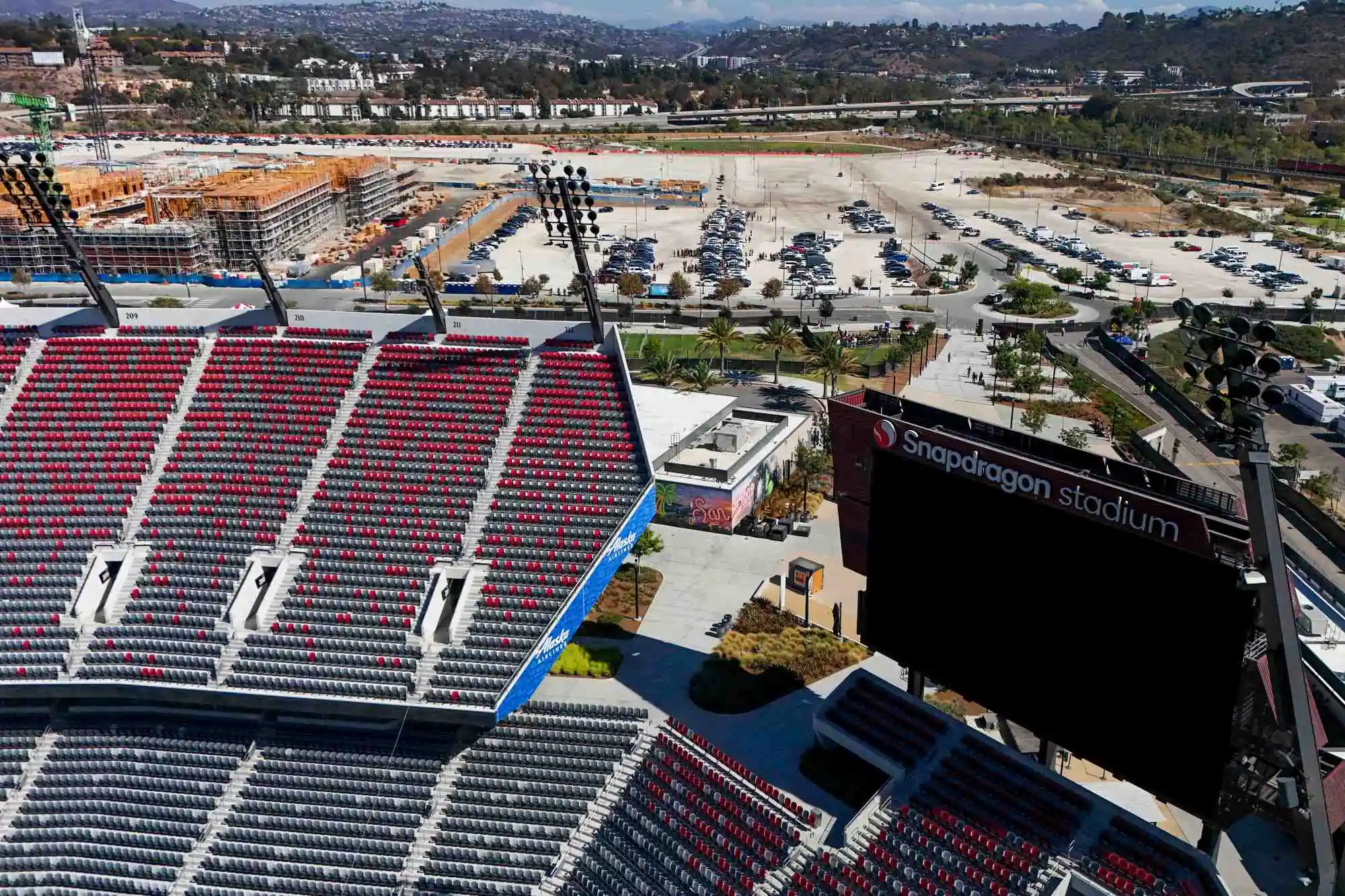
Today, that same stretch of land tells a radically different story. A 34-acre river park with native vegetation, stormwater filtration basins, playgrounds, and a two-mile trail loop sits where tailgaters once grilled. Snapdragon Stadium anchors a mixed-use district that already hosts San Diego Wave FC, San Diego FC, concerts, and rugby matches. Construction cranes mark the rise of hundreds of apartments, an affordable-housing complex, a senior-living community, and the first phase of a 1.6-million-square-foot Innovation District designed to link university research with the region’s biotech, defense, and cybersecurity sectors.
The transformation did not happen because the Chargers left in 2017—the city already owned the land. But the team’s departure gave San Diego a rare chance to ask what should replace a stadium that sat empty 350 days a year. Nearly a decade later, the answer is becoming visible.
A Ballot Battle and a University’s Pivot
San Diego State University initially wanted the Chargers to stay. “I think we were in the ‘How can we help you stay?’ camp,” said Gina Jacobs, SDSU’s associate vice president for Mission Valley Development. The university had long eyed the property for expansion, but only after the Chargers bolted for Los Angeles did the path open.
A heated 2018 election offered two competing visions. Measure E, the privately backed SoccerCity initiative, proposed a soccer stadium amid housing, retail, and parks. Measure G, branded SDSU West, envisioned a university campus with a stadium, housing, research facilities, and open space. Voters rejected SoccerCity with 67.4% opposed and approved SDSU West with 54.5% in favor. SDSU purchased the 135-acre site at fair market value in 2020.
“The Chargers didn’t give San Diego 135 acres when they left. The city already owned the property, but their departure allowed residents to reconsider what belonged there.”
Snapdragon Stadium: More Than a Football Venue
Snapdragon Stadium opened in 2022 with 35,000 seats and a mandate to serve more than college football. “We talked about it not just as a football facility, but as something that was going to support soccer as well,” Jacobs said. The venue now hosts the NWSL’s San Diego Wave FC, MLS expansion side San Diego FC, rugby matches, concerts, and festivals—creating year-round activation instead of eight or nine home games.
The River Park opened in late 2023, years ahead of the project’s contractual deadline. An existing MTS trolley stop provides car-free access. SDSU estimates more than 400,000 park visits in 2025 based on cellphone-location data, a figure that includes both event attendees and neighbors using trails, fields, and playgrounds.
“It has exceeded my expectations in terms of usage,” Jacobs said, “and that’s before we have anyone living or working on the site.”
Housing Takes Shape: Market-Rate, Affordable, and Senior Living
The most visible evidence that SDSU Mission Valley is becoming a neighborhood—not just a sports complex—is the construction rising beside Snapdragon Stadium. Two residential projects broke ground in 2025:
- Avalon Mission Valley (August 2025): 621 market-rate apartments and roughly 30,000 square feet of retail, including a planned grocery store.
- Addison (May 2025): A 126-unit affordable-housing partnership between SDSU and Chelsea Investment Corp., income-restricted for 55 years with priority for eligible SDSU employees. Twenty units are reserved for people with intellectual or developmental disabilities.
Both projects expect first residents in early 2028. In August, SDSU announced a proposed 250-residence senior-living community, and the state awarded $3.95 million for a National Security Hub intended to anchor the Innovation District.
Infrastructure is keeping pace. The Fenton Parkway Bridge—a new high-water crossing for vehicles, pedestrians, and cyclists—began construction in September 2025 with a fall 2027 completion target. Jacaranda Street reopened in July, extending the road network that will serve future residents and businesses.
| Project | Type | Units / Scale | Status / Timeline |
|---|---|---|---|
| Avalon Mission Valley | Market-rate apartments + retail | 621 units, ~30K sq ft retail | Broke ground Aug 2025; first residents early 2028 |
| Addison | Affordable housing (55-year restriction) | 126 units (20 for I/DD) | Broke ground May 2025; first residents early 2028 |
| Senior Living Community | Senior housing | ~250 residences | Announced Aug 2025; in planning |
| Fenton Parkway Bridge | High-water crossing | Multi-modal | Construction began Sep 2025; completion fall 2027 |
| Innovation District Phase 1 | Research/office (with Lincoln Property Co.) | ~315K sq ft across 3 buildings | Planned; National Security Hub funded $3.95M |
| One Water Laboratory | Water research facility | TBD | Broke ground Dec 2025 |
The Affordability Challenge in a High-Cost City
SDSU’s master plan allows up to 4,600 homes, with at least 10%—roughly 460 units at full buildout—reserved for affordable housing. Jacobs emphasized that affordable units are advancing alongside market-rate projects, not deferred to final phases. Another affordable phase is in the pipeline.
Yet diversity on a master plan does not guarantee affordability in a region where median home prices exceed $900,000 and rents remain among the nation’s highest. Rising construction costs, interest rates, and financing constraints have already delayed some projects and forced design adjustments.
“Certainly some timing has been affected just by those broader conditions,” Jacobs acknowledged. Under SDSU’s public-private model, developers finance construction on university-owned land through long-term ground leases. The structure preserves university ownership and generates revenue, but leaves schedules vulnerable to market cycles.
Jacobs remains confident: “The great news is we’ve executed on everything we said we would, from day one.”
The Innovation District: Betting on Research, Not Just Revenue
Among the largest pieces still to come, the Innovation District could prove the most consequential economic investment. The plan calls for 1.6 million square feet of research laboratories, offices, and collaborative space connecting SDSU researchers and students with San Diego’s biotech, defense, cybersecurity, and environmental-science clusters.
The proposed first phase, with Lincoln Property Co., includes three buildings totaling roughly 315,000 square feet. SDSU plans to occupy space alongside private tenants. A partnership with the San Diego Community College District would expand pathways into science and technology careers. The National Security Hub—backed by the $3.95 million state award—aims to link university researchers with defense companies and startups, with SDSU projecting more than 200 jobs created.
Nearby, the One Water Laboratory broke ground in December 2025. It will use the park’s stormwater systems to study watershed science and water treatment—turning the river itself into a living laboratory.
“What does San Diego need to be successful? What does San Diego State need to be successful?” Jacobs said the university keeps returning to those two questions. At full buildout, SDSU estimates Mission Valley could generate $3 billion in annual regional economic activity—a projection reflecting ambition that extends well beyond the stadium.
What Inglewood Shows—and Doesn’t Show
The Chargers’ move produced no obvious metropolitan-wide economic shock in San Diego or Los Angeles, consistent with decades of research showing limited regional effects from sports franchises. Inglewood tells a different story.
Billions invested in SoFi Stadium and the surrounding Hollywood Park development produced measurable activity within Inglewood—much of it before the Chargers played there. Construction jobs rose from 730 in 2016 to 1,263 in 2018 (a 73% increase in two years), while overall city employment fell 3.9%. That was a construction boom, not a Chargers-driven surge: SoFi and Hollywood Park broke ground in November 2016; the Chargers played in Carson through 2019. SoFi opened in 2020.
Later, Inglewood’s event economy appeared in tax receipts. Admissions-tax collections climbed from roughly $845,000 in fiscal 2018-19 to $20.75 million in 2021-22. Parking taxes rose from $1.24 million to $7.74 million by 2023-24. Those gains can’t be credited to the Chargers alone—SoFi also hosts the Rams, concerts, and major championships—nor do they establish net economic growth.
Economist Andrew Zimbalist, a leading sports-economics researcher, raised Inglewood as an exception to the conventional stadium model. Considering the scale of private investment surrounding SoFi, he said: “I can’t imagine that doesn’t have a positive macro impact in terms of generating some employment and generating output.” He added a qualifier: “That’s not the typical case.”
“Inglewood isn’t a blueprint for SDSU, but it demonstrates a narrower point: The impact of billions invested in a concentrated district can be more visible than that of a football team playing eight or nine home games. What surrounds a stadium may matter more than what happens inside it.”
Stewardship, Stormwater, and the Long View
Rob Hutsel, who has spent more than two decades advocating for the 52-mile San Diego River, welcomed earlier redevelopment proposals—including plans involving the Chargers and SoccerCity. River advocates had long wanted the public reconnected with the waterway. “From a San Diego River Park Foundation and a personal perspective,” Hutsel said, “it’s really exciting, and it’s been a remarkable transformation over a relatively short period of time.”
He also voices caution. Growing demand could strain the park’s capacity and restrict access. “It’s really important that that park remain a community public park and meet the needs of the people that live and work and visit that area,” he said. And he wants to see how the new landscape performs in serious storms: “One thing to pay attention to is what happens when it rains.”
For Hutsel, restoring eight-tenths of a mile of a 52-mile river is an invitation to reconnect more of the waterway through Mission Valley. He hopes SDSU Mission Valley becomes “a catalyst for more to think bigger and grander.”
Jacobs has her own benchmark. Ten or 15 years from now, she hopes San Diegans will conclude their trust in the university was justified—that the former stadium property fulfilled the promise voters endorsed when they approved its sale.
Conclusion: A Neighborhood Built on Public Trust
Where an old stadium once served the needs of a professional football team, an emerging neighborhood now offers San Diego an opportunity to build around the needs of its residents. The river is visible again. The trolley delivers people without cars. Housing—market-rate, affordable, and senior—is rising alongside research labs and a stadium that hosts more than football. The Fenton Parkway Bridge will stitch the district into the city’s mobility network.
The transformation is not complete. Construction schedules will shift. Affordability will remain a live question in a high-cost region. The park’s ecological performance under extreme weather is untested. And the Innovation District’s success depends on attracting and retaining the tenants and partnerships that turn square footage into jobs and discovery.
But the trajectory is clear. San Diego did not just replace a stadium; it reclaimed a river and reimagined 135 acres of its central valley. The Chargers’ departure was a wound to civic pride. What grew in its place may prove to be the more enduring legacy.
Business, Communities, Education, Entertainment, Finance, Government, News, Real Estate, Science, Society, Sports, Travel, San Diego, SDSU Mission Valley, Snapdragon Stadium, San Diego River, Qualcomm Stadium, Chargers, San Diego State University, Innovation District, Affordable Housing, Urban Development, Stormwater Management, Public-Private Partnership, Mission Valley, Inglewood, SoFi Stadium, Economic Development, River Park, Rob Hutsel, Gina Jacobs, Andrew Zimbalist