


Rafale M Lands Aboard INS Vikrant in First Carrier Trials for French Naval Fighter
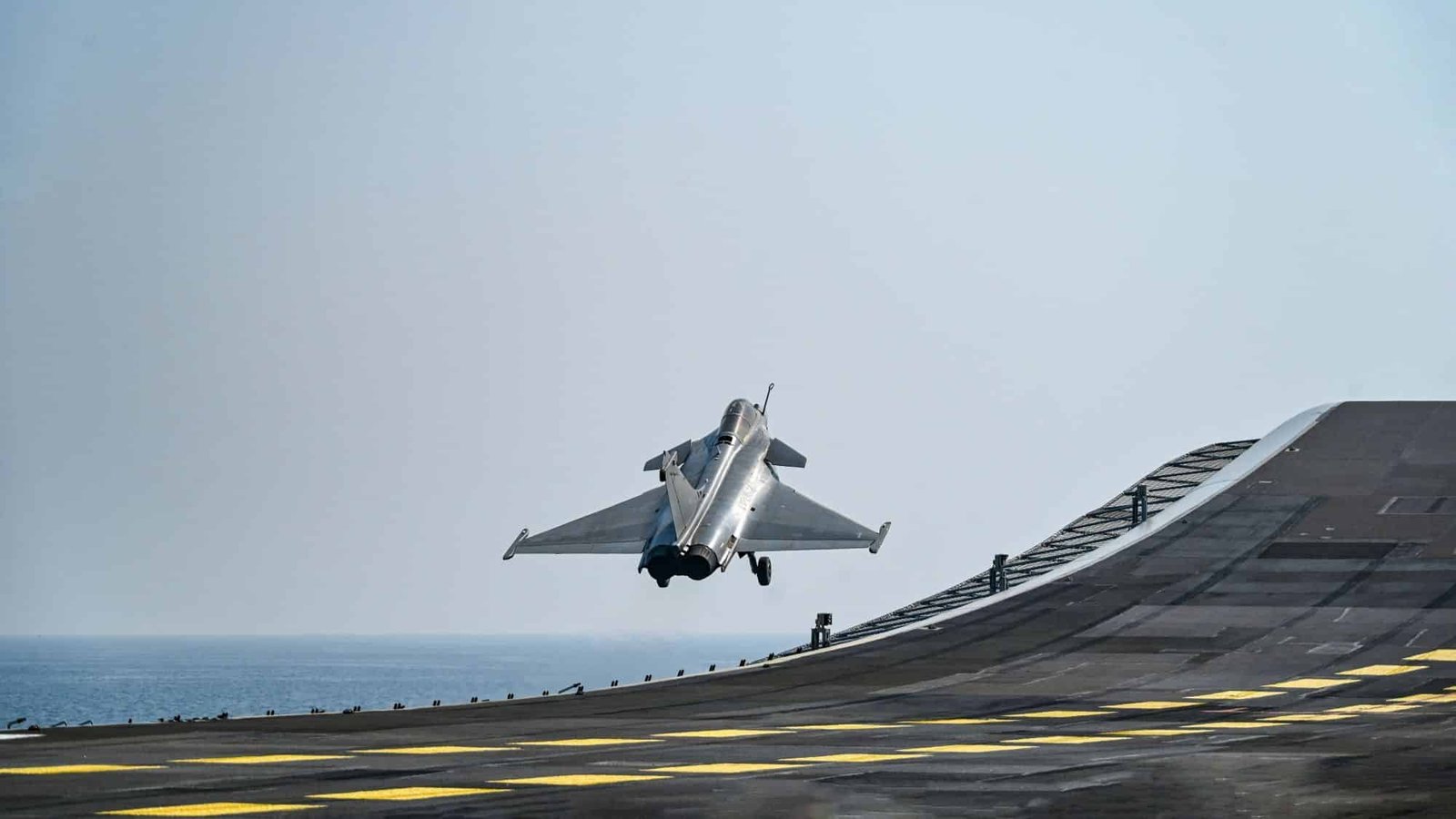
A Dassault Rafale M fighter completed its first arrested landing aboard India’s indigenous aircraft carrier INS Vikrant on October 29, 2026, and subsequently launched from the ship’s deck, the Indian Navy announced the following day. The milestone, achieved on what the service described as the “maiden attempt,” marks the first time a Rafale Marine has operated from the Short Take-Off Barrier Arrested (STOBAR) carrier. It represents a concrete step toward fielding an interim carrier-based fighter while India’s indigenous Twin Engine Deck Based Fighter (TEDBF) remains in development.
Rafale M Completes Maiden Carrier Landing on INS Vikrant
The Rafale M touched down on INS Vikrant and arrested on the carrier’s wires before taking off again, according to the Navy. Footage released by the service showed the arrested recovery, while a separate image depicted the aircraft launching from the deck, reportedly flown by a Dassault test pilot. The Indian Navy said the landing was accomplished on the “maiden attempt” and added in a post on X that “the ongoing trials mark the first steps towards operationalisation of the aircraft in the Indian Navy.”
A Rafale Marine aircraft successfully landed onboard #IndianNavy’s indigenous Aircraft Carrier #INSVikrant on its maiden attempt on 29 Oct 26.
The ongoing trials mark the first steps towards operationalisation of the aircraft in the #IndianNavy.
— SpokespersonNavy (@indiannavy) October 30, 2026
From Goa Shore Trials to Carrier Qualification
Before the shipboard trials, the aircraft conducted carrier-compatibility testing from the Shore-Based Test Facility (SBTF) in Goa, on India’s western seaboard. Images of those Goa trials emerged on social media on October 22. A land-based fighter cannot simply be deployed on a carrier; it requires a strengthened undercarriage to survive hard landings, an arrestor hook to catch the ship’s wires, a launch bar for ski-jump takeoff, and—reportedly—wingtip modifications to fit INS Vikrant’s deck elevators, though those specific changes have not been independently confirmed in detail.
The contract covers 26 Rafale Marine aircraft: 22 single-seat fighters and four twin-seat trainers, under an April 2025 intergovernmental agreement between India and France valued at approximately ₹63,000 crore, or $7.5 billion. The twin-seat variants are intended for shore-based use only, as no twin-seat carrier-capable Rafale M exists; the 22 single-seaters are expected to operate from INS Vikrant. The first aircraft are expected by the end of 2028 or early 2029, with full delivery by 2030, according to the Ministry of Defence. Officials and defence analysts stress that these are routine qualification trials and do not mean the aircraft is close to operational deployment.
| Contract Detail | Status |
|---|---|
| Aircraft type | Rafale M (Rafale Marine) |
| Order quantity | 26 aircraft — 22 single-seat, 4 twin-seat trainers |
| Agreement | India-France intergovernmental agreement, April 2025 |
| Estimated value | ~₹63,000 crore / $7.5 billion |
| First delivery | End-2028 / early-2029 (expected) |
| Full delivery | By 2030 (expected) |
What Carrier Compatibility Requires
The Goa trials are checking whether the India-specific Rafale M modifications perform as required before the jet begins flying from INS Vikrant. Similar shore-based testing has historically been used for naval fighters at INS Hansa, including earlier Rafale M demonstrations in 2022. Defence officials have confirmed that sightings of a Rafale-type jet over Goa ahead of the announcement were connected to this trial activity.
Rafale Marine Trials Underway in Goa — Carrier-Compatibility Testing for INS Vikrant
WHAT: The Indian Navy is conducting trials of the Rafale Marine (Rafale M) fighter in Goa, testing modifications required for the aircraft to operate from India’s indigenous aircraft carrier, INS Vikrant.
WHO: Indian Navy; Dassault Aviation; confirmed by Defence Officials
WHEN: Reported 22 Oct 2026; deliveries expected by end-2028/early-2029
— DefenceWithIndia (@LuharQA) October 22, 2026
Interim Role Amid TEDBF Delays
The Rafale M is intended to provide the Indian Navy with an interim carrier-based fighter capability until the indigenous TEDBF becomes available. Persistent delays in the TEDBF program have raised the possibility that India may need additional imported fighters to sustain its carrier air wing. The Rafale’s commonality with the land-based Rafales already operated by the Indian Air Force (IAF) is also expected to simplify training, maintenance, and logistics across the two services.
The TEDBF Timeline and the 57-Aircraft Question
The TEDBF, which is meant to replace the MiG-29s, was originally slated for a first flight in 2026 followed by serial production in 2029. New projections have pushed the first flight to 2029–2030. With 26 Rafale Marine aircraft already contracted, a further TEDBF delay may compel the government to acquire 31 more Rafale Ms, taking the Navy’s total Rafale fleet to 57 airframes, according to reporting by The Wire. That figure coincides with the earlier 2017 Multi-Role Carrier Borne Fighter (MRBCF) global Request for Information.
MiG-29K Limitations and the LCA Navy Setback
India’s current carrier-based fighter fleet is built around the Russian MiG-29K/KUB, which operates from both INS Vikrant and INS Vikramaditya. Approximately 40 MiG-29K/KUB aircraft of the Indian Naval Air Squadron (INAS) 303 “Black Panthers” fly from the STOBAR carrier INS Vikramaditya, a heavily modified ex-Russian Navy Gorshkov. The fleet has long faced safety, maintainability, and availability issues, with the Klimov RD-33 turbofans identified as a leading problem. India’s Comptroller and Auditor General (CAG) has noted that at least 40 out of 65 engines received from Russia had to be rejected or withdrawn due to technical problems, and components have suffered damage and failure during landing.
The Navy previously rejected the Light Combat Aircraft (LCA) Navy Mk1, primarily citing the limited capability and power of the single-engine jet. Broader concerns remain over the U.S.-made General Electric F404-IN20 engines, whose delivery delays held back the LCA Mk1A program and contributed to repeated friction between the IAF and state-run Hindustan Aeronautics Limited (HAL).
Nice shot showing an Indian Naval Air Arm MiG-29K carrier-capable multirole fighter parked with its wings folded on the flight deck of the INS Vikrant off the coast of Visakhapatnam, India, during International Fleet Review (IFR) 2026.
(/Alex Winston)
— Guy Plopsky (@GuyPlopsky) February 22, 2026
Rafale M after Mig29k n LCA Navy becomes third jet to land on INS Vikrant.
— idrw (@idrwalerts) October 30, 2026
Expanding the Rafale Fleet Across India’s Armed Forces
Both the LCA Navy and the MiG-29K had conducted their maiden tests from INS Vikrant on February 6, 2023, at a time when the Navy was struggling with both aircraft. The MiG-29K subsequently conducted a night landing on INS Vikrant on May 24, followed by a twin-carrier operation with INS Vikramaditya. The Rafale M thus becomes the third jet type to land on India’s newest carrier.
With the 26 Rafale Ms contracted for the Navy, combined with the 36 Rafales operated by the IAF, India’s combined Rafale fleet would reach 93 airframes. That figure would increase to 207 if India proceeds with the proposed procurement of 114 Rafales under the $40 billion Multi-Role Fighter Aircraft (MRFA) program, which the Defence Acquisition Council cleared in February 2026. The MRFA proposal envisions substantial domestic manufacturing, with most aircraft expected to be assembled in India. Reported indigenous-content targets have varied during negotiations, ranging from approximately 40% to 60% depending on the production batch.
Here’s #TEDBF Twin Engine Deck Based Fighter at #AeroIndia2021, Just a bit more stealthier than #IndianAirForce #Dassault #RAFALE has twin DSI inlets, bubble canopy & fold-able wings, looks more mean than #TejasMK2 model.
— 𝐊𝐔𝐍𝐀𝐋 𝐁𝐈𝐒𝐖𝐀𝐒 (@Kunal_Biswas707) February 23, 2021
Logistics, Commonality, and Strategic Implications
The Rafale M’s arrival aboard INS Vikrant underscores a broader tension in Indian defence planning: balancing urgent operational needs against long-term indigenous capability. The jet is a stopgap, not a destination. Carrier trials are a routine and necessary step before any carrier-based fighter enters service, and the current work is taking place well ahead of the 2028–29 delivery window. For now, the Rafale M gives the Navy a proven, carrier-qualified multirole fighter with commonality to the IAF fleet, while the TEDBF and MRFA programs work through their respective timelines and production challenges.
A Bridge, Not a Destination
The successful landing and takeoff from INS Vikrant validates the Rafale M’s shipboard handling characteristics and keeps the Navy’s carrier aviation plans moving forward. Whether the force ultimately operates 26, 57, or more Rafale Ms will depend on how quickly the TEDBF matures and whether the MRFA program moves from approval to contract. For the Indian Navy, the immediate priority is clear: converting a successful trial into a reliable, sea-based combat capability.
News, Government, Transportation, Science, Business, Industrial, India, France, Indian Navy, INS Vikrant, Rafale M, Dassault Aviation, TEDBF, MiG-29K, LCA Navy, Aircraft Carrier, Carrier Aviation, Defence Procurement, Aerospace, STOBAR, SBTF Goa, MRFA, HAL, GE F404-IN20, Klimov RD-33, Indo-French Defence Cooperation, Naval Aviation


