

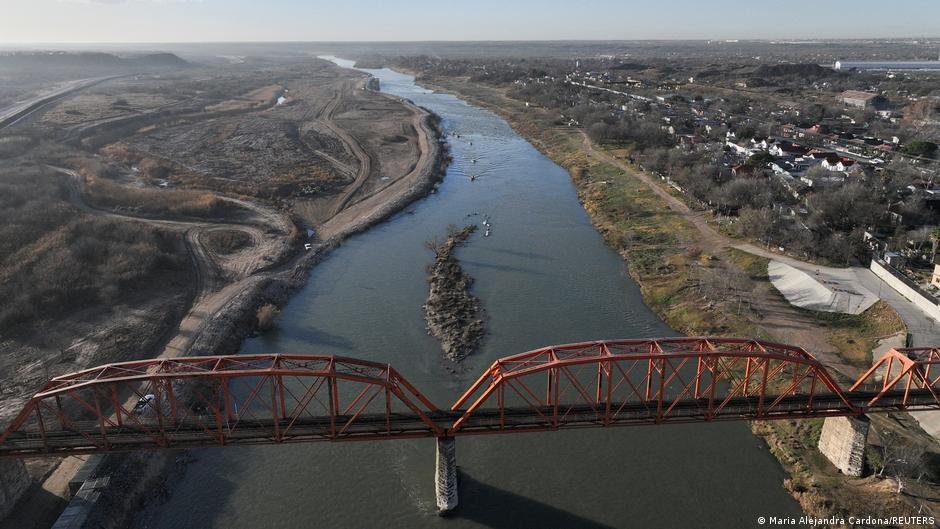

Mexico Rejects Texas Claim Over Nine Islands in Disputed Rio Bravo Border
Mexico’s federal government has firmly rejected a declaration from the state of Texas asserting ownership of nine islands located along the Rio Bravo, the river known in the United States as the Rio Grande. The dispute centers on competing interpretations of where the international boundary runs and which authority has the legal power to determine sovereignty over land formations in a shared waterway.
In a formal statement, Mexico’s Secretaría de Relaciones Exteriores said the border between Mexico and the United States “cannot be modified by decision of a state government.” The Mexican Foreign Ministry emphasized that international boundaries are defined by treaty, not by unilateral action from a U.S. state agency.
Mexico’s Foreign Ministry Pushes Back on Texas Territorial Claim
The controversy began after Dawn Buckingham, commissioner of the Texas General Land Office (GLO), announced that her office had identified nine islands “as property belonging to” Texas. According to Buckingham, state law enforcement could access, supervise, and protect the islands, including removing any illegal activity found there.
Mexico’s response was swift and unequivocal. The Foreign Ministry noted that the 1970 Boundary Treaty between the United States and Mexico establishes the international division along the center of the river’s normal channel. That same treaty determines sovereignty over lands on either side of the frontier.
“The border between Mexico and the United States cannot be modified by decision of a state government. Its limits are defined by criteria established in an international treaty.” — Secretaría de Relaciones Exteriores, Mexico
What the 1970 U.S.–Mexico Boundary Treaty Establishes
Under the Treaty on Boundaries between the United States and Mexico, signed in 1970, the international boundary follows the center of the normal channel of the Rio Bravo/Rio Grande. The treaty also specifies that neither country may build works that, in the judgment of the boundary commission, could divert or obstruct the river’s normal flow.
Crucially for this dispute, the treaty assigns exclusive authority over boundary determinations to the International Boundary and Water Commission, known in Spanish as the Comisión Internacional de Límites y Aguas (CILA). The commission is the body empowered by both national governments to apply the treaty and decide on which side of the limit any given island is located.
Texas General Land Office and Commissioner Dawn Buckingham’s Statement
Buckingham’s office stated that once the GLO confirmed the nine islands belonged to Texas, state authorities could act to secure them. The declaration reflects a broader pattern of U.S. state-level involvement in border security and immigration enforcement, but it has now collided with federal-level diplomatic protocol between two sovereign nations.
Mexico made clear in its note that no state authority possesses the legal attribution to determine island placement along an international river. The Foreign Ministry’s position is that only the binational commission can make that determination, regardless of what a state land office concludes.
The Role of the International Boundary and Water Commission
The International Boundary and Water Commission operates as a joint U.S.–Mexico institution responsible for boundary demarcation, water distribution, and environmental stewardship along the shared border. In cases involving shifting river channels, sediment deposits, or newly exposed land, the commission evaluates geography and treaty language before issuing a determination.
Because rivers can change course over time, island ownership along the Rio Bravo/Rio Grande is not always static. Historical precedent shows that such questions are typically resolved through technical boundary commissions rather than through statements from state governors or land commissioners.
No State Authority Over International Boundary Determinations
Mexico’s Foreign Ministry underscored that Texas, as a U.S. state, cannot unilaterally redefine an international frontier. Even if Texas identifies land as state property, that identification does not override treaty-based border definitions or the commission’s jurisdiction. The diplomatic note served as a reminder that federal foreign policy, not state land management, governs relations with a neighboring country.
| Issue | Mexico’s Position | Texas’ Claim |
|---|---|---|
| Legal framework | 1970 U.S.–Mexico Boundary Treaty | State-level property identification |
| Authority over islands | International Boundary and Water Commission (CILA/IBWC) | Texas General Land Office |
| Can border change unilaterally? | No, not by a state government | Asserts state ownership and access |
Why the Dispute Matters for U.S.–Mexico Relations
Although the immediate subject is nine river islands, the disagreement touches on sensitive issues of sovereignty, federalism, and cross-border cooperation. U.S.–Mexico relations have frequently been tested by migration enforcement, water sharing, and security operations along the Rio Bravo/Rio Grande. A state-level claim to territory on the international river risks complicating those broader discussions.
For now, Mexico’s position rests on treaty law and binational institutional authority. Unless the International Boundary and Water Commission issues a ruling supporting Texas’ geographic assessment, the Mexican government considers the islands’ status unresolved by any state declaration. Observers will be watching whether the U.S. federal government defers to its treaty obligations with Mexico or allows state agencies to take the lead in borderland territorial claims.
Reporting by gs, drawing on AFP and El Universal.
Government, News, Law, Society, Mexico, United States, Texas, Rio Grande, Rio Bravo, International Boundary and Water Commission, Border Dispute, Territorial Sovereignty, 1970 Boundary Treaty, Diplomacy, Dawn Buckingham, AFP, El Universal


