


Wall Street Slides as Oil Spikes and Tech Stocks Weigh on Major Indices
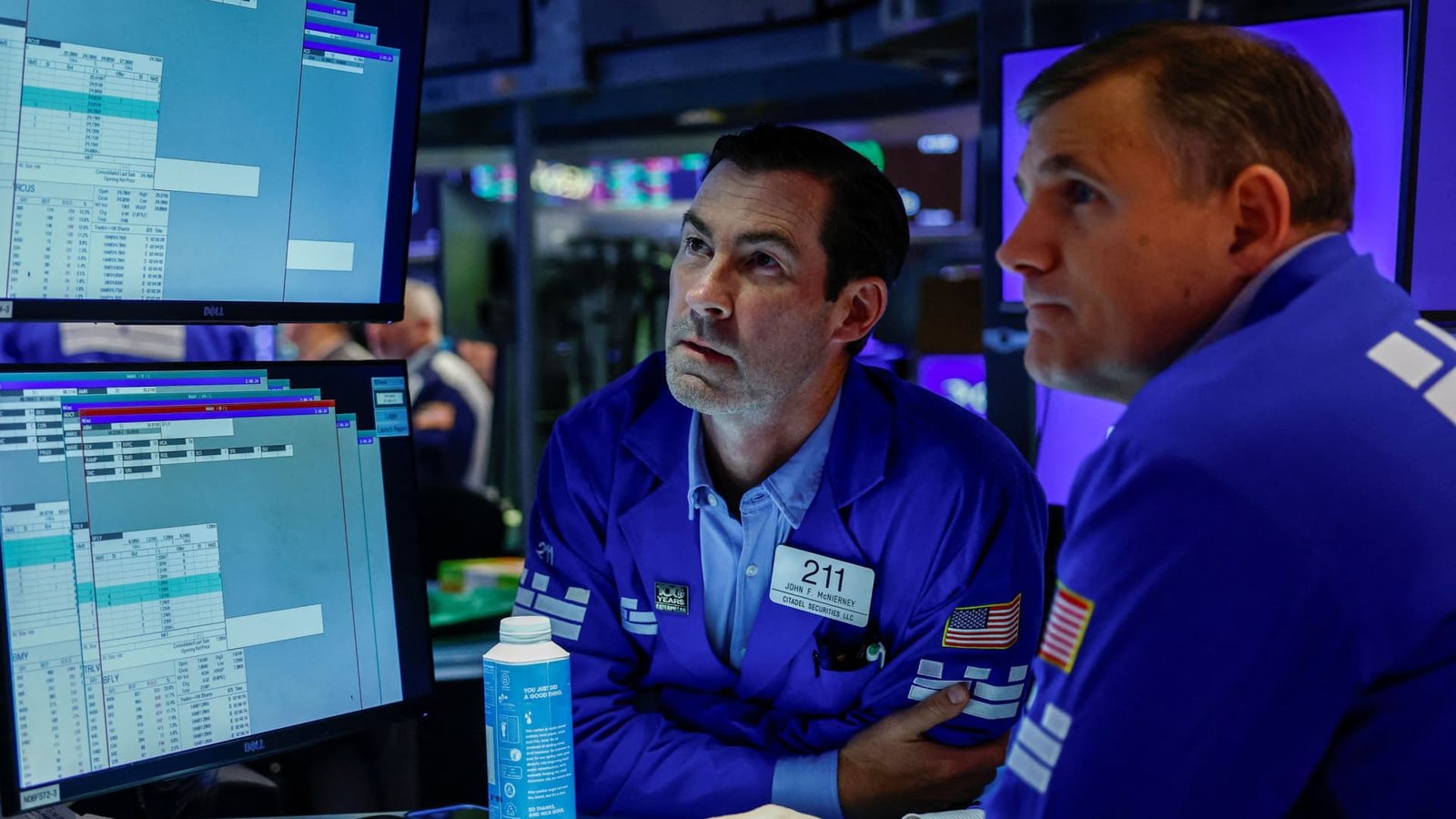
Traders work on the floor of the New York Stock Exchange (NYSE) in New York City. Jeenah Moon | Reuters
Major U.S. stock indexes retreated on Thursday as a convergence of macroeconomic anxieties and sector-specific news rattled investor sentiment. The pressure came from three distinct directions: rising oil prices driven by Middle East tensions, a disappointing revenue outlook for artificial intelligence heavyweight OpenAI, and stubbornly high Treasury yields that have pushed interest rate expectations back toward the front of the queue.
The broad benchmark S&P 500 dipped 0.6%, while the technology-heavy Nasdaq Composite fell 1.2% as growth stocks struggled under the weight of higher borrowing costs. The Dow Jones Industrial Average proved comparatively resilient, shedding only 55 points, or 0.1%. Despite the intraday decline, the market’s ability to hold recent ground highlights the volatility investors are now pricing into a persistently hawkish Federal Reserve environment.
Oil Prices Surge on Middle East Escalation Fears
Energized by geopolitical uncertainty, energy prices spiked earlier in the session following comments from President Donald Trump regarding potential conflict with Iran. Reports indicated the administration was preparing for “massive bombing” in the Middle East without seeking a deal to end the war, prompting a flight to safety that pushed crude higher.
While Trump later tempered the rhetoric, noting the U.S. would not attack Iran before the midterm elections early next month, the initial shock moved markets decisively. Brent crude was last seen up 3% at approximately $103 per barrel. West Texas Intermediate futures advanced a similar 3% to around $90. That energy inflation is the primary catalyst for the day’s equity downturn, as it reignites fears that the Fed will need to keep rates elevated for longer to combat sticky price pressures.
| Index / Commodity | Move | Level |
|---|---|---|
| S&P 500 | Down 0.6% | -0.6% (Close) |
| Nasdaq Composite | Down 1.2% | -1.2% (Close) |
| Dow Jones Industrial Avg. | Down 55 pts | -0.1% (Close) |
| Brent Crude | Up 3% | ~$103 / barrel |
| WTI Crude Futures | Up 3% | ~$90 / barrel |
| 10-Year Treasury Yield | Down >3 bps | 5.244% |
Technology Sector Stumbles After OpenAI Revenue Report
Adding to the downbeat sentiment, shares of key technology names came under significant pressure after the Financial Times reported that OpenAI’s annualized revenue is approximately $20 billion short of the amount previously signaled to investors. The shortfall has triggered a re-rating of the AI trade, with companies closely tied to the infrastructure supporting the boom facing sell-offs.
Oracle shares dropped more than 5% as a data-center partner, while leading chipmakers Nvidia and Advanced Micro Devices lost 3% and 4%, respectively. The decline signals that the market is beginning to scrutinize the monetization timeline for artificial intelligence investments more critically than in recent months.
“At the end of the day, I think it’s inflation pressures, primarily driven by energy, that have shifted the Fed’s disposition and have in a lot of ways shifted the long end of the curve as well,” said Ross Mayfield, Baird investment strategist. “If we announced a deal with Iran tomorrow that was structurally sound and removed a lot of the tensions from the area, and oil dropped from $90 a barrel to $70 a barrel, yields would come down meaningfully.”
Treasury Yields Reach 24-Year Highs
Traders were also closely monitoring the sovereign bond market after the 10-year and 30-year yields scaled to fresh 24-year highs earlier in the week. The benchmark 10-year yield was last seen down more than 3 basis points at 5.244%, while the 30-year yield was down 4 basis points at 5.621%. Those intraday moves followed a solid 30-year auction by the Treasury.
Yields and oil have stoked volatility in equities of late, as concern grows that higher energy prices will keep inflation elevated and force the Federal Reserve to further raise rates. While Mayfield noted equities have been “pretty resilient” overall, with the S&P 500 and Nasdaq notching fresh all-time highs this week, he warned it would “take much of a move higher” on the long end of the yield curve to spell “more significant headwinds” for stocks.
What Higher Yields Mean for the Economy
Baird’s Mayfield believes yields could stabilize in the 5% to 6% range, suggesting the market is currently in a process of adjustment to these new levels. In his view, higher yields are reflective of stronger nominal growth and slightly higher inflation. This creates an argument for a “higher-for-longer or normal-for-longer rate environment” that is likely here to stay, barring a big recession where the Fed cuts rates to zero.
For corporate borrowers, this means capital expenditure planning is becoming more difficult. For investors, the divergence between equity highs and yield highs suggests a market that is pricing in growth despite the cost of capital, a tension that remains fragile.
Palantir Rises on Goldman Sachs Upgrade
Amid the broader tech sell-off, Palantir Technologies stood out as one of the few stocks trading higher on Thursday, with shares gaining 2%. The rally came after the firm received an upgrade at Goldman Sachs.
The investment bank called for more upside ahead, arguing the total addressable market could be “setting up for another step function change.” Goldman highlighted the shift toward sovereign AI and bespoke applications as key drivers for Palantir’s growth, providing a counter-narrative to the broader skepticism surrounding OpenAI’s revenue guidance.
Conclusion: A Fragile Equilibrium in a High-Rate World
Thursday’s trading session serves as a reminder of how quickly macroeconomic data and geopolitical headlines can override technical momentum. With oil prices tied to the volatile Middle East, Treasury yields near multi-decade highs, and AI valuations facing renewed scrutiny, the market is in a delicate balancing act.
Investors will now be watching how the Fed responds to energy-driven inflation and whether the long end of the curve can stabilize in the 5% to 6% range that strategists like Mayfield predict. Until that adjustment completes, expect continued volatility to remain the defining feature of the current market cycle.
Business, Finance, News, Computers, Internet, Society, Government, People, Reference, Wall Street, Stock Market Today, Oil Prices, Technology Stocks, Federal Reserve, Artificial Intelligence, Geopolitics, Middle East, Treasury Yields, Palantir, Nvidia, Oracle, OpenAI, Financial Markets